12 Best Dark Web Monitoring Tools: Detect Data Leaks Before They Spread
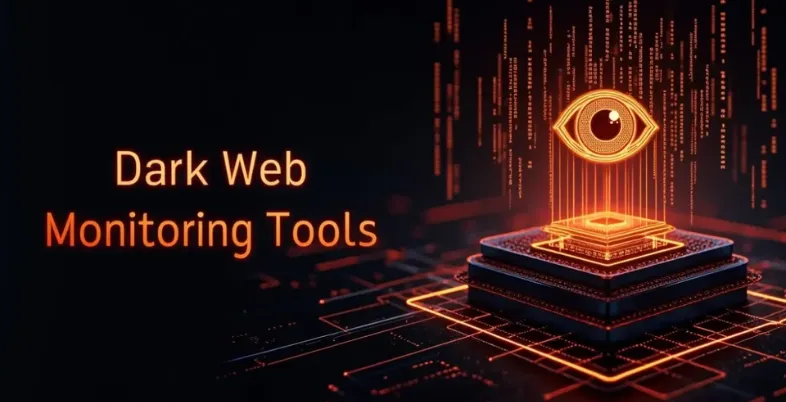
The Dark Web, the encrypted, non-indexed area of the internet that cannot be accessed via regular search engines, is the center stage of cybercrime. Such a black market enables the exchange of stolen credentials, financial information, Personally Identifiable Information (PII), and intellectual property. To the common people, it is not using the Dark Web, but rather selling and abusing their own confidences there.
Dark Web Monitoring Tools have emerged as essential defenses against such threats, helping individuals and organizations detect when their sensitive data appears on underground forums. Dark Web Surveillance Solutions must also be proactive tools that patrol such forums, markets, and chat rooms to find indicators of your breach of data. They also serve as your online scouts, notifying you as soon as your email address, credit card number, or social security number is offered on the market. By 2026, powerful monitoring will not be an exclusive security feature but an essential element of personal cybersecurity.
What is Dark Web Monitoring?
Dark Web surveillance is an active method in which dedicated software algorithms with frequent supplementary massive databases of historical breach attacks constantly search and scan the material published in hidden, private forums and marketplaces.
How Monitoring Works:
- Data acquisition: Data acquisition tools are used in collaboration with the intelligence agencies or to receive data feeds provided by law enforcement and cybersecurity companies that have gained access or penetrated Dark Web markets.
- Keyword Scanning: This technology allows the user to input certain key identifiers (e.g., primary email addresses, particular credit card number, driver’s license number, phone number, etc.). The monitoring tool searches these feeds in order to find out exact matches.
- Notification Generation: In case a match is found, that is, your email address and a hash of your password in a list named LinkedIn Dump 2024 the service sends a notification prompting the user to change the password that was compromised and protect the corresponding account.
Why You Can’t Rely on Search Engines:
Even the normal search engine such as Google or Bing is restricted to the Surface Web (about less than 5% of the internet). The Dark Web supports sophisticated encryption layers (such as the Tor network) and special domain names (.onion), along with which the usage cannot be tracked without special software and access protocols.
The Scope of the Threat: Data Breaches and Compromised Credentials
The necessity to monitor actively can be explained by the impressive industry figures:
- Credential Theft Dominance: Hackers on the Dark Web posted more than 300 million private records in hundreds of breaches in the first nine months of 2025, with email addresses and passwords being the most frequently exposed combination of data (almost 90%). This highlights the credential harvesting that is unending and widespread.
- High Risk of Account Takeover: It has been found that the spread of stolen credentials is the major cause of further cyberattacks. In the case of organizations whose credentials are compromised in the Dark Web, there is a higher risk of cyberattack 2.56 times. The increased risk is applicable to both people, in which a stolen email/ password is used to invade all the other associated accounts.
This manual centers on the publicly available resources, such as websites, software, and services that enable an ordinary user to search the Dark Web with their compromised data without applying specific knowledge and skills related to using Tor browsers, or accessing.
List of Top 12 Accessible Dark Web Monitoring Tools
1. Have I Been Pwned? (HIBP)
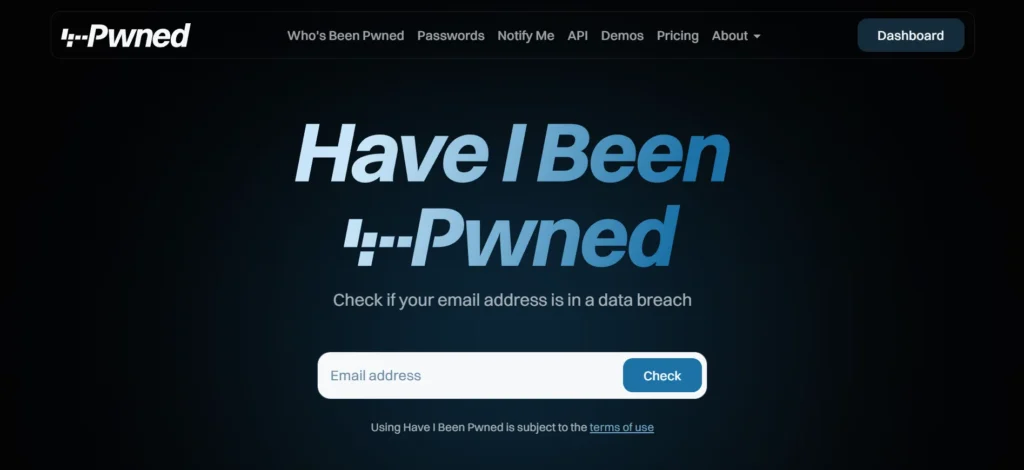
- Website: haveibeenpwned.com/
- Pricing: Free (Basic Email Search Utility)
Have I Been Pwned? Checking the credential exposure is based on (HIBP) as the basic and free tool. It compiles and tabulates billions of records of public and privatized data breaches. Even though it is reactive (it simply enumerates information that has already been uncovered), its giant database offers unmatched historical reach. It also has an option of a future alert service called Notify Me, which acts as the ultimate first line of protection for each individual user around the world.
- Pros: Largest size of the database and the extent of the historical coverage; absolutely free and open; credible collective utility.
- Cons: Firstly, reactive; has a small-scale range (only email and telephone numbers); live scanning of forums is not done.
2. DarkOwl (DarkOwl Vision)
- Website: https://www.darkowl.com/
- Pricing: Quote-Based (Enterprise/Law Enforcement). The average purchaser spends $70 200 in CTI platforms in a year.
DarkOwl is a company that gathers and webinertises data from the darknet and Deep Web. As one of the leading Dark Web Monitoring Tools, DarkOwl Vision is technically a specialized search engine of the Dark Web, allowing law enforcement, government agencies, and cybersecurity specialists to access real-time intelligence services on cyber threats, compromised PII, and illegal transactions. Its main advantage is that it has been built upon proprietary TOR continuous indexing and deep-level search capabilities.
- Pros: Huge proprietary dark web index (searchable database), could be used to deep investigate and threat hunt, robust API integrations to be used by enterprises.
- Cons: very high cost, more than an enterprise-level pricing, and a steep learning curve with a complicated platform interface.
3. Recorded Future (Threat Intelligence Platform)
- Website: https://www.recordedfuture.com/
- Pricing: Enterprise/CTI Platform/Quote-Based. The average customer spends an amount of $70200 in a year.
Recorded Future is a popular threat intelligence that is characterized by well-developed Dark Web monitoring. It uses proprietary machine learning and human intelligence to combine intelligence from open, deep, and dark web. This will enable it to deliver timely, actionable information on how to be proactive in security, which in many cases is aimed at foreshadowing attack trends as well as prioritizing risks. It is designed to support big companies and government agencies that need a complete CTI and threat prioritization.
- Pros: Utilizes high-tech AI/ML to make predictions on potential threats, includes numerous automation options and integrations into existing security applications (SIEM/SOAR), and includes abundant alert context.
- Cons: High cost, Premium pricing can be difficult when an interface is needed, which is complex to a non-Security Operations Center (SOC) user.
4. Digital Shadows
- Website: https://reliaquest.com/solutions/digital-shadows/
- Pricing: Quote-Based (Digital Risk Protection). The average price is expensive and varies with monitored assets.
Digital Shadows provides the platform of Digital Risk Protection (DRP) named SearchLight. It patrols the surface, deep, and dark web to detect things that threaten the company, like information leakage, identity hijacking, and uncovered corporate resources. Digital Shadows does a fantastic job in offering a single and easy-to-use platform, which offers an eye view of an organization’s online presence as an attacker. Its main benefit is less attack surface, pointing out vulnerable assets and analyst-vetted intelligence with low false-positive results.
- Pros: Interface that is easy to use; a powerful emphasis on brands and digital risk protection (DRP); coverage of the surface, deep, and dark web sources.
- Cons: Mainly aimed at corporate properties, not so available to end users; the remediation/take-down service may be difficult.
5. Flashpoint
- Website: https://flashpoint.io/
- Pricing: Quote-Based (Business Risk Intelligence). The base entry pricing is about 80,000 a year.
Focusing on Business Risk Intelligence (BRI) and a profound understanding of hacker obscurity, Flashpoint is a specialized platform in this field. As one of the most effective Dark Web Monitoring Tools, it provides threat intelligence from Dark Web forums, marketplaces, encrypted chat rooms, and social platforms. Flashpoint is widely used to defend business-critical systems, detect insider threats, and trace fraudulent activity. Financial institutions and security teams rely on its intelligence feeds to track stolen data and monitor criminal discussions related to their organizations.
- Pros: Business risk intelligence is great; chat room and private messaging intelligence are more well-established; fidelity and threat data are highly actionable.
- Cons: Charges premium prices; deals with the needs of enterprises almost exclusively.
Suggested Read: Free VPN Services
6. SpyCloud
- Website: https://spycloud.com/
- Pricing: Quote-Based (Credential and Account Takeover Protection). Average cost ~$38,000 annually.
SpyCloud is a technology-based enterprise that concentrates on restoring and regaining stolen credentials and identity information prior to their utilization to take over accounts. It runs a continuous surveillance of Dark Web forums, stealer logs, and other communications by criminals and warns users and companies when their passwords and PII have been stolen. The main value is assisting organizations to avoid immediate financial losses by discovering invalid user credentials promptly (in a few minutes), and connecting with systems to conduct automated password resets.
- Pros: fast speed of recovering the credentials (and alert) (many times it is minutes); targeted at account takeover and financial fraud prevention; high integration to be used with automated remediation.
- Cons: Firstly, it is mainly targeted at stealing credentials, thus needs to be combined with additional security tools to have a holistic perspective; expensive.
7. Cyble
- Website: https://cyble.com/
- Pricing: Enterprise and MSP Quote-Based Solutions. Entry level ~$7,900 annually.
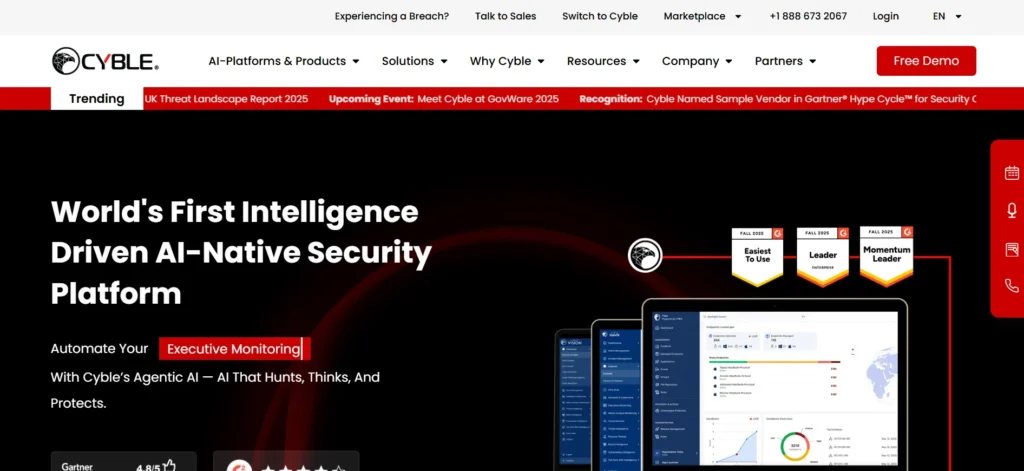
Cyble offers an all-encompassing Dark Web and Deep Web surveillance service that is based on AI-native threat data. Its service, Cyble Vision, focuses on attacking data proactively, with the ability to select data on various sources of the dark web, such as TOR, I2P, and ZeroNet. Cyble has mastered the ability to monitor card breaches, endpoint information as well as documentation, and provides a comprehensive strategy of sealing loopholes in cybersecurity defense. It applies AI to find connections between data points and give out early breach notification.
- Pros: AI-based analysis to identify breaches early; can follow numerous types of dark web protocols (TOR, I2P); has easy-to-use dashboards that can help evaluate cyber risk.
- Cons: Needs the dedication of their entire solution stack to be the most effective; needs a dedicated security team that will exploit the intelligence feeds to the fullest.
8. KELA
- Website: https://www.kelacyber.com/
- Pricing: Quote-based (CTI Platform). This begins at around 65000 per annum.
KELA delivers actionable and situationalized threat intelligence, the results of Dark Web chatter and communication networks of criminals. The platform of KELA is programmed to eliminate noise so that only verified intelligence is provided, along with its specific assets and risks of a company. The service is beneficial to the security teams as it allows them to gain insight into the tactics, techniques, and procedures (TTPs) of malicious actors and respond to the incident swiftly and hunt threats. It is also greatly appreciated due to the real-time information that it retrieves through the forums of criminals that are privately run.
- Pros: Gives very practical, contextualized intelligence; is very much focused on TTPs and analysis of criminal intent; filters information to minimize information overload.
- Cons: earmarked towards security analysts; expensive in terms of the type of intelligence it offers.
9. SOCRadar Advanced Dark Web Monitoring
- Website: https://socradar.io/
- Pricing: Tiered Subscription-Based (Tiered plans). High-level DWM is about 7,900 each year.
SOCRadar is a company that provides high-grade Dark Web Monitoring solutions built with advanced search algorithms and configurable feeds. As one of the most comprehensive Dark Web Monitoring Tools, its platform uncovers hidden threats by tracking PII exposures, detecting threat actors, and delivering real-time alerts. SOCRadar allows organizations to customize monitoring based on industry needs, such as Financial Services or Healthcare, making threat detection more targeted and effective. It leverages vast data sources to conduct extensive threat hunting and enhance overall cybersecurity posture.
- Pros: Customizable monitoring by industry; emphasizes finding executive PII and VIP protection; builds on a comprehensive XTI (eXtended Threat Intelligence) platform.
- Cons: Costly to the enterprise; needs to be added to their wider platform to be fully functional.
10. Flare Systems
- Website: https://flare.io/
- Pricing: SaaS Pricing Service (Quote). Expensive, custom-made to corporate requirements.
Flare Systems offers a total Dark Web monitoring and cyber threat intelligence solution in the form of a SaaS. Billions of data points on hundreds of obscure websites, thousands of cybercrime Telegram channels, and credential dumps are archived by Flare. The platform’s reputation has an ease of use and fast deployment, thus it can be accessed by companies both big and small in need of a security team. The flare specializes in fast detection of data leaks and external threats on an easy-to-use platform.
- Pros: Singleton delegate platform; easy, user-friendly interface; fast drop environment; good Telegram channel and credential dump coverage; fits well with limited security teams.
- Cons: Majorly centered around exposure to external threats, and not in-depth forensic investigation; needs a subscription to access full services.
11. ID Agent (Dark Web ID)
- Website: https://www.idagent.com/
- Pricing: Subscription-Based (Has been sold mainly via MSPs). Billed at a minimum of 10 users at $5 per user/month.
ID Agent is a company that deals with monitoring services to Managed Security Service Providers (MSPs). The Dark Web ID platform continuously scans to identify compromised user credentials by sending verified alerts and intelligence that can be rapidly remedied. It is offering ongoing, approved credential tracking to MSPs to guard the databases of their clients on employees and customers as a vital safeguard on their systems to protect against massive account takeover assaults.
- Pros: Empirical credential checks are very reliable in terms of real-time credential monitoring, excellent MSP platform to handle numerous clients, as the validated alerts ensure that false positives are minimal.
- Cons: Does not sell directly to individual consumers; intelligence is very oriented towards credential data.
12. CrowdStrike Falcon Recon
- Website: https://www.crowdstrike.com/en-us/
- Pricing: Quote-Based (to License Falcon Endpoints). Expensive, as a component of Enterprise bundles.
CrowdStrike Falcon Recon is a special module of the Falcon platform that is dedicated to external threat intelligence. It also proactively scans the Dark Web, mentioning corporate assets, executive PII, and exposed credentials based on a huge threat intelligence network developed by CrowdStrike. Recon is designed to integrate Dark Web monitoring into equivalent endpoint security and threat hunting processes of organizations with a goal of providing extra cover of defense to their security operations center (SOC).
- Pros: EBPs with major EDR/XDR systems; effectively monitors corporate assets; takes advantage of a big threat intelligence network.
- Cons: Can not be obtained separately as a consumer good; is expensive in relation to the enterprise endpoint protection ecosystem.
Comparison Table: Top Dark Web Monitoring Tools
| Tool Name | Pricing Model | Key Features | Pros | Cons | Ideal For |
|---|---|---|---|---|---|
| Have I Been Pwned? (HIBP) | Free | Checks email/phone in breach databases; “Notify Me” alert feature | Free, huge database, easy to use | Reactive only, limited to email/phone | Individuals |
| DarkOwl (DarkOwl Vision) | Quote-Based (Enterprise/Law Enforcement) | Proprietary TOR indexing, deep search engine, real-time threat data | Massive dark web index, API integrations | Very expensive, complex interface | Enterprises & Law Enforcement |
| Recorded Future | Quote-Based (Enterprise CTI) | AI + human intelligence, predictive analytics, automation | Predictive threat intelligence, broad integrations | High cost, complex for non-SOC users | Large Organizations |
| Digital Shadows (SearchLight) | Quote-Based (DRP) | Monitors surface, deep & dark web; brand protection | User-friendly, strong digital risk coverage | Expensive, limited for individuals | Enterprises |
| Flashpoint | Quote-Based (Business Risk Intelligence) | Dark web forums & chat monitoring, financial crime intelligence | Actionable intelligence, great for insider threat detection | Premium pricing, enterprise focus | Financial Institutions, Enterprises |
| SpyCloud | Quote-Based (~$38,000/year) | Credential recovery, ATO prevention, automation | Very fast alerts, great integrations | Expensive, limited focus on credentials | Corporates & Security Teams |
| Cyble (Cyble Vision) | Quote-Based (~$7,900/year) | AI-powered, covers TOR/I2P/ZeroNet, proactive threat detection | AI-based analysis, customizable dashboard | Needs full suite for best results | Enterprises & MSPs |
| KELA | Quote-Based (~$65,000/year) | Criminal TTPs, verified intel, low noise feeds | Highly contextualized intel, TTP focus | Expensive, analyst-oriented | Security Analysts |
| SOCRadar Advanced DWM | Tiered Subscription (~$7,900/year) | Customizable by industry, real-time alerts, extended threat intel | Industry-specific focus, executive PII protection | Pricey enterprise model | Enterprises, Regulated Sectors |
| Flare Systems | Quote-Based (SaaS) | Telegram, credential dumps, fast deployment | User-friendly, quick detection, fits small teams | Limited forensic depth | SMEs, Security Teams |
| ID Agent (Dark Web ID) | Subscription-Based ($5/user/month via MSPs) | Continuous credential scanning, verified alerts | Great for MSPs, accurate alerts | Not for individual users | MSPs, IT Service Providers |
| CrowdStrike Falcon Recon | Quote-Based (Enterprise Bundle) | Integrates with EDR/XDR, external threat intelligence | Excellent corporate coverage, integrates with Falcon | Enterprise-only, high price | Corporations & SOC Teams |
Conclusion
This is the reality of the modern internet: at some point, your personal information has likely been exposed in a data breach. To stay protected, using advanced Dark Web Monitoring Tools is essential, as they provide proactive alerts that help you contain the damage before cybercriminals can exploit your data.
Basic protection services like Have I Been Pwned? and Firefox Monitor offer a good starting point, but for comprehensive identity theft protection, financial reimbursement, and active PII monitoring, premium Dark Web Monitoring Tools such as LifeLock or Aura provide the most extensive coverage and reassurance. By adopting these services, you can transform a potential vulnerability into a managed and controlled risk.
FAQs
1. What Is The Dark Web, And Is It Legal To Visit?
Dark Web is the cryptic component of the deep internet and is directed through such networks as Tor where anonymity is of the essence. There is no wrong in visiting the Tor browser or at least using the browser itself is not an illegal activity, but it is only illegal to be involved in illegal activities (such as purchasing or selling smuggled commodities) within the browser.
2. What Is The Difference Between Dark Web Monitoring And Antivirus Monitoring?
Antivirus guarantees the safety of your computer (files, programs) against malware. Dark Web monitoring keeps your identity and credentials safe by scanning data against external, illegal markets and finding your personal information. They are layers of security, which are complementary to each other.
3. What Should I Do Immediately In Case My Email Is Found On HIBP?
You are advised to change the password of that email account immediately, as well as any other account in which you used the same password. Additionally, implement Multi-Factor Authentication (MFA) on the exposed account and high-value (banking, cloud storage) services.
4. Are High-End Dark Web Surveillance Services Able To “Hack” The Dark Web?
No. Respectable services do not engage in any illegal activities. They access data through legal intelligence feeds, by collaborating with law enforcement agencies that have seized server data, or by buying publicly available data dumps.
5. Why Are Password Managers Providing Monitoring?
Password management systems such as Dashlane and Keeper include monitoring features to fight credential stuffing. When a hacker steals a password, they often try it across multiple sites. To prevent this vulnerability, monitoring notifies users about compromised credentials immediately and recommends replacing them in the secure vault environment.