

The rise of eSIM technology is transforming how people connect to mobile networks, making traditional SIM cards increasingly obsolete. An eSIM, or embedded SIM, is built directly into your device, allowing you to activate a cellular plan digitally without needing a physical card. This innovation has paved the way for a new generation of eSIM providers offering flexible, instant, and global connectivity solutions.
Whether you’re a frequent traveler, remote worker, or business user, eSIM provider deliver seamless network switching, competitive data plans, and enhanced convenience. With leading companies like Airalo, Nomad eSIM, and Holafly, users can access reliable coverage across multiple countries without roaming hassles. As smartphones, tablets, and even wearables increasingly support eSIM, these providers are becoming essential for modern, borderless communication.
What Is an eSIM and How Does It Work?
An eSIM, or embedded SIM, is a digital version of the traditional SIM card that is built directly into your device, such as a smartphone, tablet, or smartwatch. Unlike physical SIM cards that need to be inserted or replaced, an eSIM allows users to activate a mobile network plan remotely through software. This means you can switch carriers, add new data plans, or manage multiple numbers without physically changing anything in your device.
The technology is designed to offer greater flexibility, especially for travelers and business users who need quick access to different networks. It also saves space inside devices, enabling slimmer designs and improved durability.
How Does It Work?
- An eSIM is embedded as a small chip inside your device during manufacturing.
- Mobile network providers assign a digital profile to your eSIM instead of issuing a physical SIM card.
- You can activate a plan by scanning a QR code or downloading a carrier profile via an app.
- The eSIM securely stores multiple network profiles, allowing you to switch between them easily.
- It connects to the nearest available network just like a regular SIM, ensuring seamless connectivity.
- Users can manage, add, or remove plans directly from their device settings without needing a store visit.
Why Switch to eSIM In 2026?
Switching to eSIM is no longer just a tech upgrade—it’s a practical shift toward faster, more flexible, and global connectivity. As smartphones and networks evolve, eSIM has become the preferred choice for users who want instant activation, seamless switching, and hassle-free mobile management.
Unlike traditional SIM cards, eSIM removes physical limitations and enables a fully digital experience, making it especially useful for travelers, remote workers, and modern businesses. With growing support from telecom providers worldwide, eSIM is now considered a future-ready solution that enhances convenience, security, and efficiency in everyday mobile usage.
Key Benefits Of Switching To eSIM
- Instant Activation: Activate your mobile plan within minutes by scanning a QR code—no store visits or waiting required.
- Easy Carrier Switching: Change networks or plans digitally without replacing a SIM card.
- Multiple Profiles: Store and switch between several numbers or plans on one device.
- Perfect for Travel: Use international data plans instantly without buying local SIM cards.
- Enhanced Security: eSIM cannot be physically removed, reducing risks like SIM theft or misuse.
- Dual SIM Convenience: Use personal and work numbers on the same phone easily.
- Eco-Friendly: Eliminates plastic SIM cards and reduces environmental waste.
- Space Efficiency: Frees up internal device space, enabling slimmer and more durable designs.
Overall, eSIM in 2026 offers a smarter, faster, and more flexible way to stay connected—making it a clear upgrade over traditional SIM cards.
Quick Comparison Table – Best eSIM Providers
| Provider | Coverage | Starting Price | Best For | Rating |
| Airalo | 190+ countries | $4.50 | Budget travelers | 4.8 |
| Holafly | 160+ countries | $9.90 | Unlimited data users | 4.7 |
| Saily | 190+ countries | $3.99 | Privacy-focused travelers | 4.7 |
| Nomad | 100+ countries | $4.50 | Frequent flyers | 4.5 |
| Roamless | 200+ countries | Pay-per-use | Occasional travelers | 4.4 |
| Jetpac | 100+ countries | $1.00 | Ultra-budget travelers | 4.3 |
| Keepgo | 150+ countries | $14.00 | Long-term travelers | 4.5 |
| Airtel eSIM | 50+ countries | $3.00 | South Asia travelers | 4.3 |
| GigSky | 190+ countries | $9.99 | Business travelers | 4.4 |
| Ubigi | 190+ countries | $5.00 | European travelers | 4.4 |
| Truphone | 80+ countries | $6.00 | Enterprise/business users | 4.4 |
| Flexiroam | 150+ countries | $4.99 | Frequent Asia/Europe travelers | 4.3 |
List of 12 Best eSIM Providers
1. Airalo
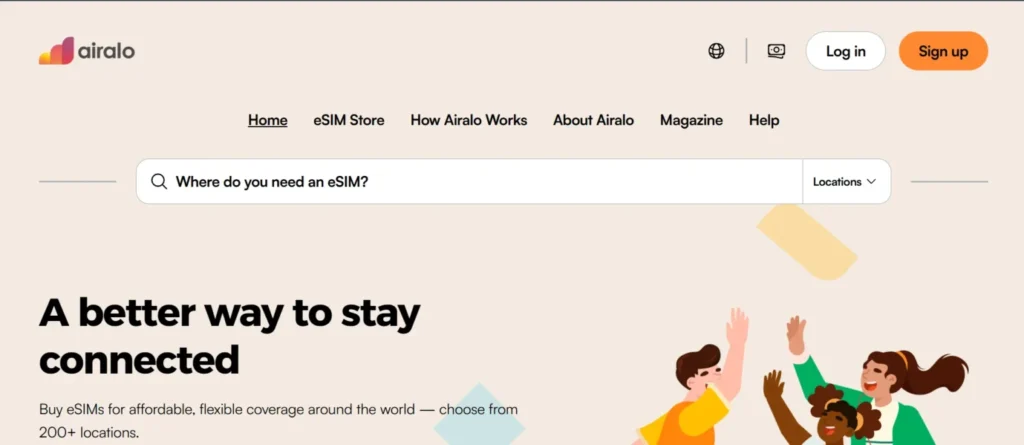
Airalo is the largest eSIM market in the world featuring local, regional and global plans in the 190+ countries. Most travelers turn to it due to its huge plans selection, easy-to-use application and dependable 24/7 service. Airalo has almost definitely a plan that includes the needed data for a particular country or a continent in general, at a reasonable cost.
Key Features:
- Plans to 190+ country and region plans.
- Allows call and texting on some plans.
- Easy to use app with simple top-up and control.
- 24/7 customer support
- Referral discounts available
Coverage and Network Quality:
- 190+ countries and 4G and 5G coverage in all key markets. Depend on the use of local carriers and thus the speed will vary depending on the nation but tend to be consistent.
Pros:
- A largest variety of countries and plans.
- Far too easy to be used by those who are not experts.
- Flexible and competitive pricing.
Cons:
- Some developing countries have a low speed of data.
- None of the unlimited data plans.
- The service to customers in the peak seasons is slow.
Who Should Use?
- Perfectly suited to those who are casual and budget travelers who travel to one or two nations and desire a stripped-down, but quality journey.
Price:
| Plan | Data | Duration | Price |
| Starter | 1 GB | 7 days | $4.50 |
| Standard | 3 GB | 30 days | $11.00 |
| Plus | 10 GB | 30 days | $27.00 |
2. Holafly

Holafly is the most suitable one, when you wish to have unlimited amount of data but are not concerned about the balance of what you have consumed. It is sold in 160+ countries, and is particularly well received by those traveling to Europe, the US, and Latin America. Plans are easy to use set a time upfront, pay and use data without limitations.
Key Features:
- Extensive data on any plans.
- Allows sharing of data across devices.
- None of the contracts, or auto-renewals.
- WhatsApp/live chat support.
- One-step activation of QR.
Coverage and Network Quality:
- 160+ countries covered, and 4G is performing well in Europe and the Americas. 5G in the select destinations.
Pros:
- Indeed endless data – no most plans limited.
- Good in case of heavy streamers and video callers.
- Excellent customer support through WhatsApp.
Cons:
- A little more expensive than data-capped products.
- Most plans do not have voice call support.
- Less coverage in some areas of Asia and Africa.
Who Should Use?
- Ideal for traveling digital nomads and remote workers, as well as those with high data usage on a daily basis.
Price:
| Plan | Data | Duration | Price |
| Basic | Unlimited | 5 days | $9.90 |
| Standard | Unlimited | 15 days | $19.90 |
| Extended | Unlimited | 30 days | $34.90 |
3. Saily
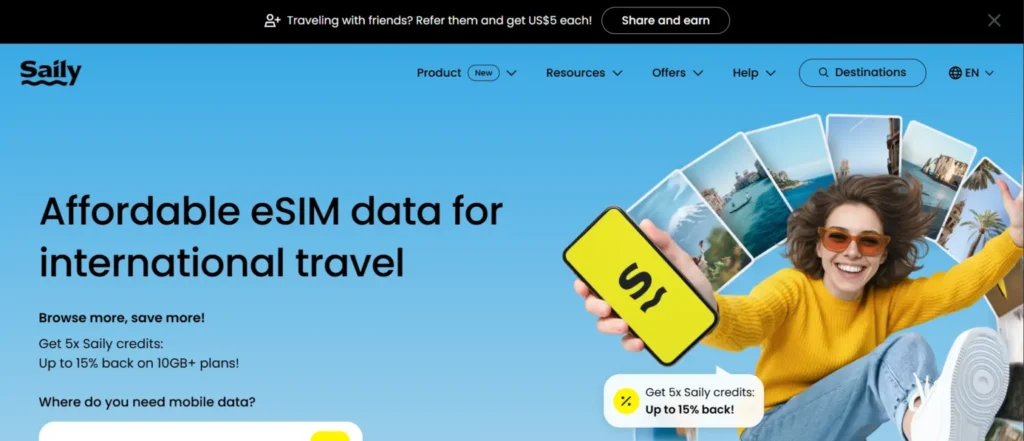
Saily is a more recent eSIM service that is created by the same team as NordVPN, which implies that privacy is pre-established. It serves 190+ countries and the option to have an in-built VPN and ad blocker (including select plans). Since it is backed by a VPN-focused team, it can be a good choice for users who are already familiar with tools like NordVPN . In case you are concerned with both connectivity and online security when traveling, Saily is the most one-stop shop.
Key Features:
- Coverage in 190+ countries
- Inbuilt VPN and ad blockers.
- Aliases many eSIMs on a single account.
- There are limitless data packages on offer.
- Quick QR code activation.
Coverage and Network Quality:
- 190+ countries with strong 4G/5G networks in North America, Europe and Asia. Well-established network relationships in the international circles.
Pros:
- In-built VPN provides a true security level.
- Global coverage at competitive prices.
- Easy multi-profile management
Cons:
- Newer brand that is less known.
- Unlimited plan is costly as opposed to alternatives.
- VPN feature is optional.
Who Should Use?
- Most ideal when it comes to privateness-loving travellers seeking to have connectivity and security all in a single application.
Price:
| Plan | Data | Duration | Price |
| Starter | 1 GB | 7 days | $3.99 |
| Standard | 5 GB | 30 days | $12.99 |
| Unlimited | Unlimited | 30 days | $59.99 |
4. Nomad
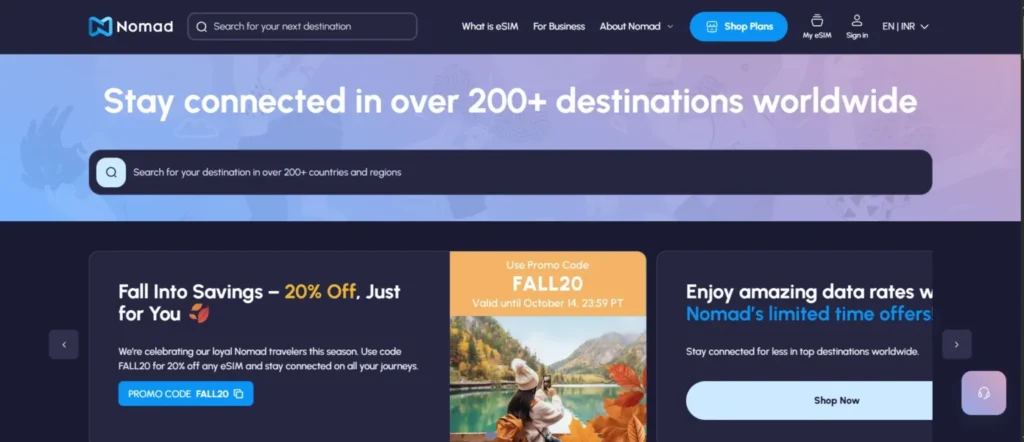
Nomad has flexible data options in over 100 different countries, and the app experience is generally slick, and new users are challenged with a free welcome eSIM. It targets the frequent flyers who travel between countries frequently and require plans that do not require them any hurdle in adapting to other areas.
Key Features:
- Coverage in 100+ countries
- Welcome eSIM which is free and that too to first time users.
- Live, in-app customer support chat.
- Switching of regional plans quickly.
- Basic QR code activation.
Coverage and Network Quality:
- 100+ countries with good 4G networks. 5G in a limited number of markets. Characterized by a small narrower coverage than Airalo but good coverage performance.
Pros:
- Excellent interface and experience.
- Free welcome eSIM is an excellent initial bonus.
- Stable speeds in countries covered.
Cons:
- Less than the leading competitors.
- None of unlimited data.
- Offering slightly higher price on small amounts of data.
Who Should Use?
- Best suited to frequent users of an app looking to have a polished experience and travel in fully covered areas.
Price:
| Plan | Data | Duration | Price |
| Lite | 1 GB | 7 days | $4.50 |
| Standard | 3 GB | 30 days | $12.00 |
| Pro | 10 GB | 30 days | $28.00 |
5. Roamless
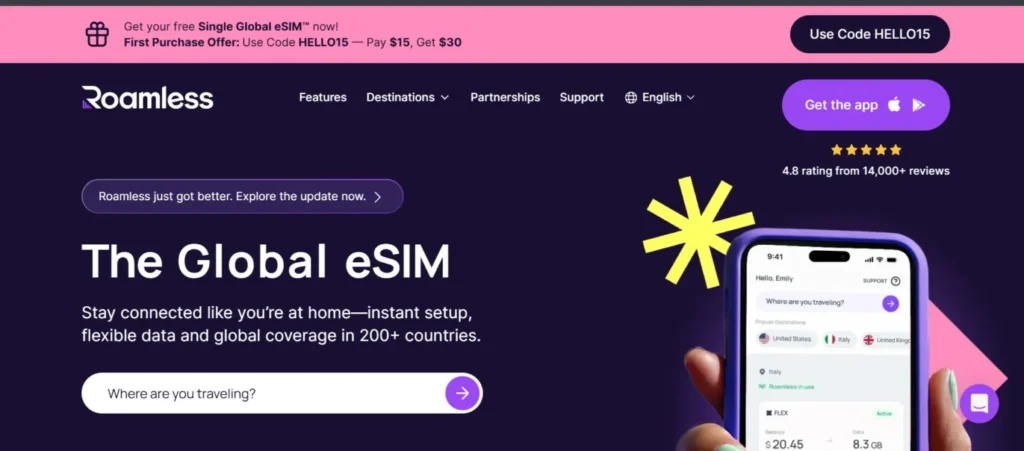
Roamless is on the pay-as-you-go scheme – just pay as much as you actually use. No monthly commitments made and no wastage of data. It serves over 200 countries, which is why it is one of the most far-reaching in this list. It is the most flexible in terms of its usage by travelers who make occasional trips or have unpredictable schedules.
Key Features:
- No-subscription pricing (pay-per-use).
- Coverage in 200+ countries
- Multi-profiling and multi-device.
- There is no expiry date on bought information.
- Simple app management
Coverage and Network Quality:
- 200+ countries, one of the most extensive coverage maps. 4G everywhere; 5G where available.
Pros:
- Only pay as much as what you consume – no waste.
- The widest country coverage in this list.
- No monthly fee or pledge.
Cons:
- Can be costly to hard data users.
- Increased uncertainty in terms of pricing.
- App not usable as easy as competitors.
Who Should Use?
- Ideal when these patrons are occasional visitors and do one to two trips annually and are not willing to stick to a set plan.
Price:
- Personal pricing, depending on the use of the data and the country. Usually costs between $0.05 and $0.20 per MB by destination
6. Jetpac
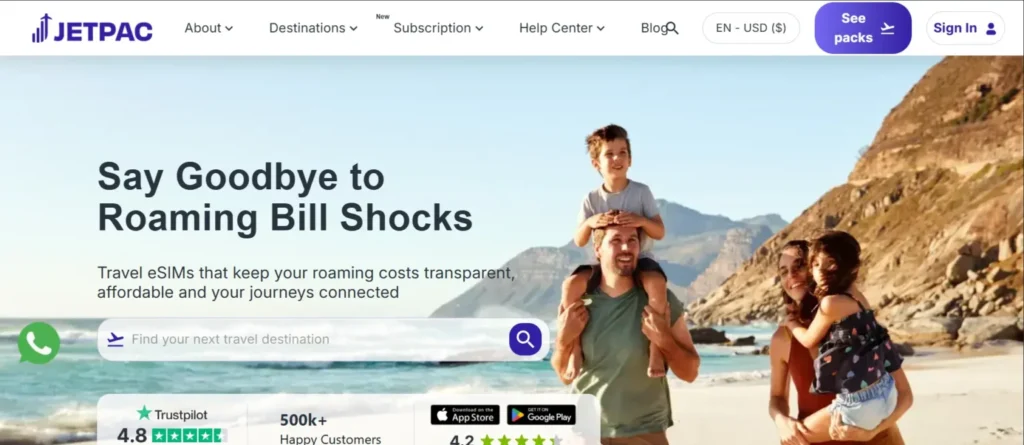
Jetpac is the cheapest eSIM provider on this list with plans starting from $1. It offers 4G and 5G coverage in a strong list of countries and is ideal for those who want to check their email and browse the web on the go without breaking the bank. It has an easy set-up and user-friendly app.
Key Features:
- Plans starting from $1
- 4G and 5G networks
- Multi-country coverage
- Flexible plan durations
- Simple step-by-step activation
Coverage and Network Quality:
- 100+ countries – 4G widely available. 5G is supported. It’s not a global network, but works for many popular holiday destinations.
Pros:
- Most affordable plans anywhere
- Good for short, simple trips
- Simple and hassle free
Cons:
- Less coverage than leading companies
- No unlimited data option
- Limited customer service
Who Should Use?
- Ideal for low budget short-term travellers who need some browsing and maps at a low cost.
Price:
| Plan | Data | Duration | Price |
| Micro | 500 MB | 7 days | $1.00 |
| Basic | 1 GB | 7 days | $2.00 |
| Standard | 3 GB | 30 days | $7.00 |
7. Keepgo
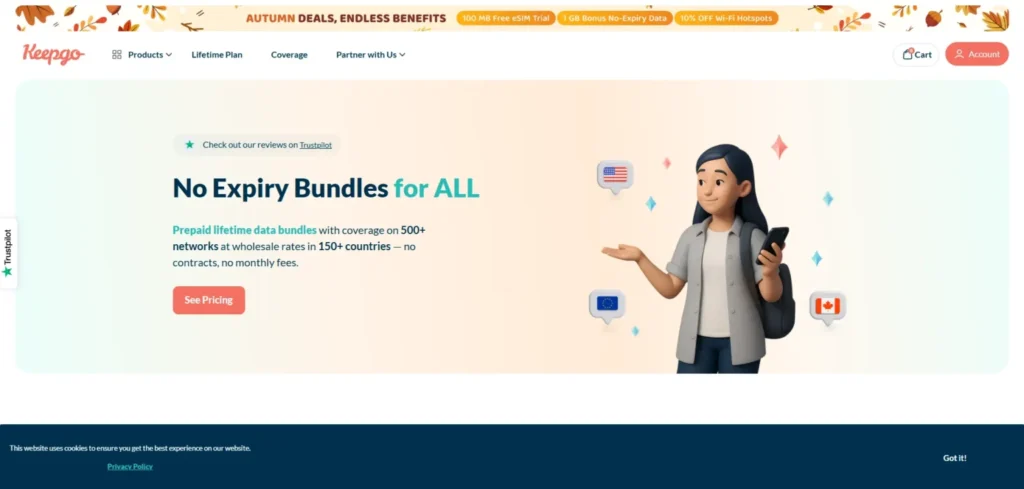
Keepgo is known for its long-term, fee-free data plans. Data never expires (must renew once a year). It is valid on 500+ networks & 150+ countries and can be shared via tethering – making it a very powerful option for annual travellers.
Key Features:
- Plans are valid for a year
- Supports 500+ networks in 150+ countries
- Allows sharing with hotspot
- No month-to-month fees or commitments
- 4G and 5G capable
Coverage and Network Quality:
- 150+ countries on 500+ networks. Excellent multi-carrier support ensures good fallback options in single carrier zones.
Pros:
- No data expiration – good for occasional users
- Cross-network coverage for better service
- Tethering allowed on all plans
Cons:
- More expensive than short-term contracts
- Not suitable for large data usage
- Less beginner-friendly interface
Who Should Use?
- Best for people who travel often and for work trips or those who want a plan for the year without having to renew every month.
Price:
| Plan | Data | Duration | Price |
| Starter | 1 GB | 1 year | $14.00 |
| Standard | 5 GB | 1 year | $35.00 |
| Pro | 10 GB | 1 year | $60.00 |
8. Airtel eSIM
Airtel eSIM is a very popular choice among South Asian users, especially for those who travel throughout India and other South Asian countries. It uses the Airtel telecommunication system, which ensures top-notch service in the region. It’s a great choice if you are looking for a company with good coverage.
Key Features:
- Coverage in 50+ countries
- Excellent 4G/5G in India & South Asia
- Simply activate on the Airtel Thanks app
- Instant QR code setup
- 24/7 customer support
Coverage and Network Quality:
- 50+ countries all with excellent 4G and 5G in India. It offers more limited coverage outside Asia, but works for some holiday hotspots.
Pros:
- Excellent coverage in India, South Asia
- #1 telephonic brand in India
- Cheap for those travelling within Asia
Cons:
- Regional (mostly Asian) coverage
- No unlimited data plans
- App look can be out of date compared to competitors
Who Should Use?
- Ideal for domestic travel in India and across South Asia to have a cheap and reliable plan with a storied brand.
Price:
| Plan | Data | Duration | Price |
| Basic | 1 GB | 7 days | $3.00 |
| Standard | 3 GB | 28 days | $8.00 |
| Plus | 10 GB | 28 days | $20.00 |
9. GigSky
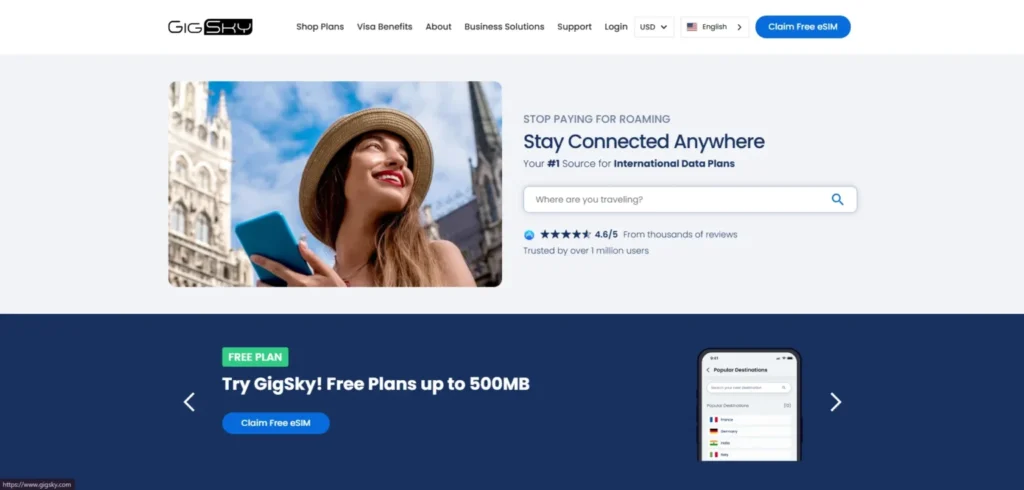
GigSky is a top-notch eSIM provider that specialises in reliable global coverage with clear and transparent plans. It works in 190+ countries, and is ideal for business travellers looking for reliable service without bogging down in different plan options.
Key Features:
- Coverage in 190+ countries
- Easy, hassle-free plan selection
- Compatible with iPhones, iPads and some Androids
- Global data with speedy 4G coverage
- Convenient QR code and app scanning to activate
Coverage and Network Quality:
- 190+ countries with reliable 4G service. Excellent coverage in Europe, USA and Asia. Uses reliable partnerships with local providers for support.
Price:
| Plan | Data | Duration | Price |
| Starter | 1 GB | 30 days | $9.99 |
| Standard | 3 GB | 30 days | $24.99 |
| Pro | 5 GB | 30 days | $39.99 |
Pros:
- Great global coverage in 190+ countries
- Simple and easy plans
- Great for Apple device users
Cons:
- More expensive than low-cost options
- No unlimited data plans available
- Only two plan sizes to choose from
Who Should Use?
- Recommended for business trips and Apple users who want an easy plan, without complications of multiple payment options and plan sizes.
10. Ubigi
Ubigi is a French-based company with 190+ country coverage, and particularly good coverage in Europe and Asia. It’s the only provider that also offers connected car solutions. Ubigi is ideal for tech-forward customers seeking robust coverage options, a variety of data plans, and a fair price.
Key Features:
- Coverage in 190+ countries
- Various plans for connected car eSIM
- Data rollover on select plans
- Top-up from the app
- Multi-device support
Coverage and Network Quality: 190+ countries with great 4G in Europe and Asia. 5G in a few countries. Best across Europe (home continent).
| Plan | Data | Duration | Price |
| Light | 1 GB | 30 days | $5.00 |
| Standard | 3 GB | 30 days | $13.00 |
| Plus | 10 GB | 30 days | $29.00 |
Pros:
- To a good presence in both Europe and Asia
- Unique connected car eSIM support
- Rollover data is a great incentive
Cons:
- Not as popular as other brands outside Europe
- no unlimited data plans
- Can take time to get service
Who Should Use?
- Most suitable for those who travel in Europe, tech-savvy users looking for good coverage, competitive prices, and a range of extras such as device sharing, and rolling over data that doesn’t get used.
11. Truphone
Truphone is a leading eSIM provider that caters to business and enterprise customers. It provides coverage in many major markets around the world, and is recognised for its high-quality network service and excellent support, making it a popular option for business users with high demands for reliable service.
Key Features:
- Coverage in 80+ countries
- Business plans with invoicing
- Manage devices from dashboard
- Instant QR code activation
- 24/7 dedicated customer support
Coverage and Network Quality:
- 80+ countries with good 4G/5G in North America, Europe and Asia-Pacific. Has own networks in major markets, providing more reliable speeds than resellers.
Pros:
- Faster speeds with owned network in key markets
- Ideal for business with account managers
- Consistent and established brand
Cons:
- Narrower geographic coverage than the best
- No unlimited data plans
- More expensive than budget options
Who Should Use?
- Ideal for corporate users and business traveler who want the quality of the network and corporate support, rather than the cheapest price.
Price:
| Plan | Data | Duration | Price |
| Starter | 1 GB | 30 days | $6.00 |
| Standard | 5 GB | 30 days | $18.00 |
| Pro | 10 GB | 30 days | $32.00 |
12. Flexiroam
Flexiroam is an eSIM pioneer, having started with the “sticky sim” and now fully supporting eSIM. With 150+ countries covered, it is unique in offering a subscription plan that benefits heavy users with reduced per GB costs.
Key Features:
- Coverage in 150+ countries
- Plans with rollover data
- App with data usage and alerts
- All plans allow tethering/hotspot
- Works on a diverse set of Android and iOS devices
Coverage and Network Quality:
- 150+ countries and consistent 4G in Asia, Europe and the Americas. 5G in some countries. Decent multi-carrier fallback for areas with sporadic single-carrier coverage.
| Plan | Data | Duration | Price |
| Basic | 1 GB | 30 days | $4.99 |
| Standard | 5 GB | 30 days | $14.99 |
| Premium | 15 GB | 30 days | $34.99 |
Pros:
- Unused data rolls over from month to month
- All plans allow tethering
- Well-established and trusted brand
Cons:
- App design is somewhat outdated
- No unlimited data option
- Limited coverage in Africa/Middle East
Who Should Use?
- Best for those who travel a lot in Asia and Europe and are looking for a subscription plan with a roll-over feature and good tethering ability.
Suggested Read:
How To Choose the Right eSIM Provider For You
Choosing the right eSIM provider isn’t about picking the “most popular” option—it’s about matching the provider to how you travel, how much data you use, and where you’re going. In 2026, providers differ mainly in coverage, pricing models, speed, and features like unlimited data or security tools, so understanding your needs is key before deciding.
1. Check Coverage First
- Make sure the provider supports all the countries you’re visiting. Some providers offer 100+ countries, while others go beyond 200, which is crucial for multi-country trips.
2. Understand Your Data Needs
- Light usage (maps, WhatsApp): go for budget plans (e.g., Airalo-type providers)
- Heavy usage (streaming, work): choose unlimited data providers like Holafly-style plans
3. Compare Pricing Models
- Fixed data plans (1GB–10GB): cheaper and predictable
- Unlimited plans: higher cost but no usage stress
- Pay-as-you-go: best for occasional travelers
4. Look at Network Quality & Speed:
- Not all eSIMs give the same speed—some depend on local carriers, so performance can vary by country.
5. Check App Experience & Ease of Use:
- A good provider should offer quick activation, easy top-ups, and a simple interface for managing plans.
6. Consider Extra Features
- Hotspot/tethering support (important for remote work)
- Built-in VPN or security tools (e.g., privacy-focused providers)
- Customer support (24/7 chat is ideal)
7. Match It to Your Travel Style
- Short trips → budget & simple plans
- Frequent travel → global or regional plans
- Remote work → unlimited data + hotspot support
How To Activate An eSIM – Step by Step
Activating an eSIM is a quick and fully digital process that eliminates the need for a physical SIM card. Whether you’re using an iPhone or an Android device, the setup typically takes just a few minutes—as long as you have a stable Wi-Fi connection and a QR code or activation details from your carrier.
For iPhone Users:
- Open Settings on your device
- Tap Mobile Data or Cellular
- Select Add eSIM or Add Cellular Plan
- Choose Use QR Code
- Scan the QR code provided by your eSIM provider
- Follow on-screen instructions to complete setup
- Label your eSIM (e.g., Work, Travel) and select it as default if needed
For Android Users:
- Go to Settings
- Tap Network & Internet or Connections
- Select SIM Cards or Mobile Network
- Tap Add eSIM or Download SIM
- Scan the QR code or enter activation details manually
- Confirm and activate your plan
- Set preferences for calls, SMS, and data usage
Important Tips:
- Ensure your device supports eSIM before starting
- Stay connected to Wi-Fi during activation
- Restart your device if the network doesn’t appear immediately
- Keep the QR code safe in case you need to reinstall the eSIM
Once activated, your eSIM will connect to the network automatically, allowing you to start using data, calls, and messages right away.
eSIM vs Physical SIM – Which Is Better?
| Feature | eSIM | Physical SIM |
| Convenience | Activate instantly from anywhere | Requires physical card and insertion |
| Cost | Often cheaper, especially for travel | Can be cheaper for local long-term plans |
| Availability | Built into most modern phones | Works on virtually all phones |
| Flexibility | Switch plans digitally in minutes | Must swap cards to change plans |
Conclusion
In conclusion, eSIM technology has redefined mobile connectivity by offering a smarter, more flexible, and fully digital alternative to traditional SIM cards. From instant activation and seamless network switching to global coverage and enhanced security, eSIMs are built for the needs of modern users. With leading providers like Airalo, Nomad eSIM, and Holafly delivering reliable and diverse plans, users now have greater control over their mobile experience. Whether you’re traveling, working remotely, or managing multiple numbers, choosing the right eSIM providers ensures a seamless and cost-effective way to stay connected worldwide.
FAQs
1. Can I Use eSIM With SIM?
Yes. Nearly all modern phones support dual SIM – so you could use your local physical SIM and an eSIM on your phone simultaneously.
2. Can I Add Data To My eSIM While Travelling?
Yes. Most will allow you to top up your data plan directly from their app while you’re travelling.
3. eSIMs Are Safe And Secure?
Yes. eSIMs have the same encryption as SIM cards. Operators such as Saily add a VPN for extra security.
4. What If My eSIM Doesn’t Work?
This is where your provider’s support comes in. The most common problem can be solved by scanning the QR code again or re-installing the profile from your settings.
5. Can I Use eSIMs One A Plane Or A Ship?
No. eSIMs are based on terrestrial networks. They won’t work on a plane or ship at sea unless the transportation company provides a network service.
6. Is eSIM Cheaper Than Roaming?
Yes, in nearly all cases. This is typically much more expensive than purchasing a travel eSIM plan for the region.