

10 Best Security Awareness Training Software: Strengthening the Human Firewall

Cybersecurity today is not just about firewalls, anti-viruses, or advanced endpoint protection—it’s about human beings. Studies prove that the human element always proves to be the weakest link, and over 95% of security breaches are caused by human error. A single misclick, one incorrect phishing email, or a wrong handling of a password can risk an entire company. Security Awareness Training platform bridges the gap. In contrast to traditional training, it combines interactive learning modules, life-like phishing simulations, behavioral analytics, and just-in-time coaching to educate workers and transform their behaviors.
By establishing an active culture of security, this software turns every team member into a vigilant first line of defense. In 2025, when AI-based social engineering attacks become more sophisticated and compliance measures become tighter, Security Awareness Training Software is no longer a recommendation, but a necessity. A dollar today in human-focused cybersecurity training can prevent costly breaches tomorrow and make your organization unbreakable.
What Is Security Awareness Training Software?
Security Awareness Training platform (SATS) is a purposeful training program and resource that can be used to improve human defenses of an organization by a significant degree to resist cyber attacks. Whereas firewalls, encryption, and endpoint protection keep the network and devices sound, SATS draws its protection to the user; the human element, which, as studies have shown, continuously is the weakest link in the security chain.
The software platform provides measurable and interesting multimedia content that informs employees about cyber risks and security policies and best practices. Its fundamental aim is to change the user behavior to make it proactive versus reactive and inculcate a culture of security first, which transforms every employee into a high alert first line of defense.
Key Components of Modern SATS:
- Phishing Simulation Engine: No compromise. The platform should be capable of launching very realistic, personalized phishing, spear-phishing, vishing (voice), smishing (SMS), and squashing (QR code) attacks, which are similar to real-life threat campaigns.
- Learning Management System (LMS): A powerful tool to provide micro-learning modules in the form of short messages, movies, and simulations. This has typically been done through gamification and individualized learning journeys as well as monitoring compliance (e.g., GDPR, HIPAA).
- Behavioral Analytics and Reporting: The platform should be able to monitor metrics, not just course completion. The key analytics would be the simulated dwell time (the duration of time required by an employee to report a threat) and the reporting rate (a percentage of the users reporting suspicious activity).
- Just-in-Time (JIT) Coaching: Directing a re-training (remedial) immediately, and on a personalized basis, as a failure occurs on a simulation; strengthening the behavior at the time of failure.
Why Do You Need Security Awareness Training? The Essential Defense in 2025
A need for SATS is motivated by the fact that advanced attacks are not focused on technological feats as much as they are based on psychological buffs to human nature.
1. Human Error and The Last Mile of Defense
Reports have established that 95% of every security attack can be attributed to a human factor, whether it is clicking on an inorganic link or poorly handling sensitive information, or succumbing to a social engineering tool.
Regardless of how much a given organization has invested in its perimeter defense (firewalls, EDR, anti-malware), the system is still open to an attack, provided that an employee is willing to click a link that will give the attacker access. This is where Security Awareness Training Software comes in and provides this last line of defense.
2. The Rise of AI-Powered Social Engineering
Future capabilities of the Generative AI will pervade the threat landscape in 2025.
- Personalized Attacks: AI can be used to swiftly create high-quality, highly-written spear-phishing emails, imitating internal company lingo, or spoofing the tone and the situation of an email addressed to the CEO (Business Email Compromise, or BEC).
- Scale and Speed: The pace at which such intensely targeted, customized attacks can be executed implies that staff has to be educated to get critical about reading and discern the slightest of psychological clues (urge, power) instead of type checking.
3. Compliance and Cyber Insurance Mandates
The awareness training on cybersecurity is no longer suggested, but rather it has become prescribed by the industry and regulatory authorities:
- Regulatory Requirements: Regulations such as the ISO 27001, HIPAA, and GDPR stipulate that organizations need to exhibit that they have engaged in reasonable measures to train employees about data management and data security.
- Insurance Requirements: Cases are rising where insurance companies are now requiring phishing simulation and training certificates to be carried out every quarter before issuing or renewing a policy. There is a direct correlation between the premium costs of a company and the quality of its training program. The organizations with minimal terms of awareness usually face premium rates reaching 20 percent and experience fewer losses due to breaches.
4. Protecting Against Specific Attack Vectors
Security Awareness Training Software provides the necessary defense against the most common threats:
| Attack Vector | Description | SATS Solution |
| Phishing/Spear Phishing | Fraudulent emails designed to steal credentials. Spear phishing is highly targeted. | Realistic simulation campaigns and instant reporting tools. |
| Business Email Compromise (BEC) | Impersonating a CEO/CFO to trick finance teams into wiring money. | Role-based training and multi-factor authentication enforcement. |
| Ransomware Delivery | Malware delivered via malicious attachments or links. | Training on file inspection, email hygiene, and immediate incident reporting. |
| Vishing/Smishing/Quishing | Phishing executed via voice call, SMS text, or QR code. | Multi-vector simulations to test employees across all communication channels. |
List of Top-Rated Security Awareness Training Software (Global Accessibility)
1. KnowBe4
Website: https://www.knowbe4.com/products/security-awareness-training
KnowBe4 is considered a market leader in Security Awareness Training, with a large catalog of security awareness programs that has the largest library of security awareness content and great attention to the core product, which is phishing simulation. The platform is extremely effective in designing very realistic and personalized phishing tests that focus on the roles and industries.
It has a huge library of content in the form of interactive modules, short videos, and games with a lot of humor to make matters related to security interesting. KnowBe4 offers a flexible platform on its own Kevin Mitnick Security Awareness Training methodology platform, which can be easily scaled across small businesses up to large business needs and provides an accountable remedy to adherence and quantifiable risk decrease.
Pricing:
- Starts $1.90/ month
Key Features:
- Mega library of content (modules, videos, posters)
- Simulated Phishing Platform Advanced (KMSAT)
- Phish Alert Button (PAB) – one-click reporting platform
- Compliance modules (GDPR, HIPAA)
- Auto training campaigns
Pros:
- Leading player in the market with unrivaled content richness
- Flexible simulation templates
- Powerful reporting systems for human risk assessment
- Simple platform management
Cons:
- A large volume of content can be overwhelming
- Renewal prices are expensive
- Most useful features require the highest-level subscriptions
2. Proofpoint (Formerly Wombat Security)

Website: https://www.proofpoint.com/us/products/mitigate-human-risk
Proofpoint is a cybersecurity powerhouse that makes its security awareness training software directly integrated with its cutting-edge email protection software. That is the main advantage of Proofpoint: this synergy does not only assume who is a threat; it runs on actual-world threat intelligence (threats that are hitting your network now) and behavioral analytics to identify the most vulnerable employees.
The educational material is concentrated on brief and easy-to-digest training units that are supposed to make a sustainable difference in the habits of the users. The actionable metrics of Proofpoint reporting enable security leaders to focus on training resources according to the real risk of an organization and to directly include an incident response flow within training efforts.
Pricing:
- Starts $1/ month
Key Features:
- Real-Life Threat Intelligence
- Individualized Very Attacked Person (VAP) Dashboard
- Closed-Loop Email Analysis and Response (CLEAR)
- Phishing Simulation
- Brief, Nanobite Learning
Pros:
- Direct integration with email gateway and threat intelligence
- Hyper-focused training based on existing risk profiles
- Excellent phishing simulation engine
- Robust reporting solution for large enterprise requirements
Cons:
- Solutions tend to be costly and geared toward larger companies using the Proofpoint ecosystem
- Less flexible for smaller companies
- Heavily relies on integration with other Proofpoint products
3. Cofense PhishMe
Website: https://cofense.com/phishme-security-awareness-training-(sat)-platform
Cofense PhishMe is a digital platform that focuses all its energies on boosting the human defense against phishing and advanced email attacks. Cofense focuses on the realism of its simulation engine, incorporating thousands of real-life attack cases and exploiting global threat intelligence to ensure tests always up-to-date and real.
The training is aimed at educating the employees to understand the proper indicators of social engineering by the human mind. The PhishMe tool is developed to be very flexible and ensure constant practice in a secure setting. Its reporting measures are based on the human vulnerability measures, and the effectiveness of the training to turn human behavior during a crisis.
Pricing:
- Quote-based
Key Features:
- Crowd-Sourced Attack Templates
- Advanced Phishing Simulation
- Highly realistic real-life scenarios
- Adaptive Learning Paths
- Reporting tools indicating employee susceptibility
Pros:
- Highly specialized and precise phishing simulations
- Adapts global threat intelligence to existing templates
- Effective in driving behavior change
- Strong focus on human defense indicators
Cons:
- Limited content diversity outside email phishing
- The platform interface may be challenging for beginners
4. Hoxhunt
Website: https://hoxhunt.com/
Hoxhunt is a distinctly gamified security awareness training platform approach that aims at facilitating a behavioral change in real life by using positive reinforcement and constant micro-learning. The platform is well integrated with email systems and converts phishing reports into missions, for which employees are rewarded for reporting, motivating them to identify suspicious emails.
The training is flexible and individualized: employees who do not pass a simulation are promptly coached, while those who succeed are praised, building lasting security habits. Hoxhunt makes security training interactive, continuous, and highly quantifiable, allowing real-time tracking of employee progress and measurable human risk reduction.
Pricing:
- Quote-based
Key Features:
- Gamified Learning and Missions
- Spamless Integration with Email
- Real-Time Personalized Feedback
- Adaptive Simulation (Delta Performance)
- Positive Reinforcement Model
- Multi-Language Support
Pros:
- High levels of employee engagement and knowledge retention
- Positive rewards motivate reporting behavior
- Training is continuous and integrated into daily work
- Behavioral analytics are prioritized
Cons:
- A gamified format may not suit all corporate cultures
- Requires ongoing investment for effective program management
- Relatively costly, though cheaper than bare compliance-only options
5. Terranova Security (Now Fortra)
Website: https://www.terranovasecurity.com/
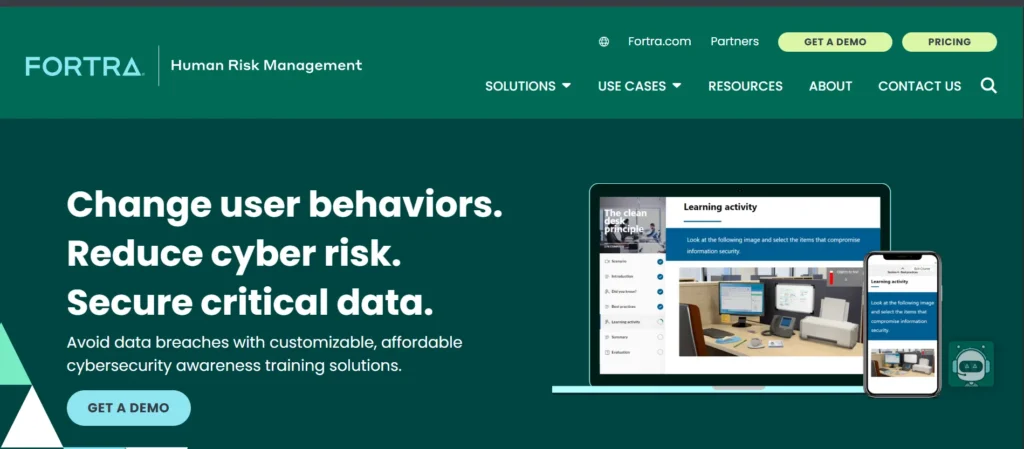
Fortra is a multi-lingual, award-winning industry leader offering security awareness training software with multi-faceted attention to policy management and compliance. The platform features a vast collection of videos, courses, and other educational materials that are cinematic, engaging, and tailored to the needs of a globally dispersed workforce.
Fortra focuses on cultivating a strong security culture by providing localized content and robust reporting features to meet complex regulatory requirements (GDPR, CCPA, etc.). Its platform ensures training not only communicates policies but also reinforces employees’ understanding of organizational security requirements.
Pricing:
- Quote-based
Key Features:
- Vast Multi-Language Content Library
- Compliance Modules (GDPR, HIPAA)
- Policy Management Integration
- Phishing Simulation Platform
- Comprehensive Reporting and Analytics
Pros:
- Ideal for multinational organizations (language and cultural relevance)
- Superior compliance tracking and reporting
- High-quality, engaging video content
- Strong focus on policy awareness
Cons:
- Highly customizable content requires careful management
- Platform management needs specific attention
- Less emphasis on behavioral change compared to Hoxhunt
6. Mimecast

Website: https://www.mimecast.com/solutions/security-awareness-and-training/
Mimecast is a cybersecurity company that provides its users with security awareness training, which is strongly embedded into its primary email and archiving functionality. The particularity of its training lies in the fact that it is based on the data about real-life employees- it scans the threat intelligence, which is aimed at the organization, and trains the users on the basis of the threat, which is causing them real problems.
Mimecast Awareness Training platform is an educational platform that utilizes brief, comedic, and memorable animated videos to send brief, high-impact lessons in an attempt to ensure security training sticks with employees who are tired of boring content. By playing with the email ecosystem, Mimecast is doing a great job by alternative to blocking risky users and customizing follow-up campaigns by using its position in the email ecosystem.
Pricing:
- Quote-based
Key Features:
- Live Contextual Training
- Cartoon and Video Material (Mini Lessons)
- Phishing Attack Simulation
- Mimecast Integration with Email Security
- User Vulnerability Reporting
Pros:
- Highly engaging content that enhances retention
- Training remains relevant via real email threat context
- Strong integration with Mimecast email security
- Brief lessons prevent learner fatigue
Cons:
- Best suited for organizations already using Mimecast email services
- Less adaptable for standalone deployment
- Cost is tied to the full security package
Suggested Read: NordVPN Alternatives
7. PhishingBox
Website: https://www.phishingbox.com/solutions/security-awareness-training
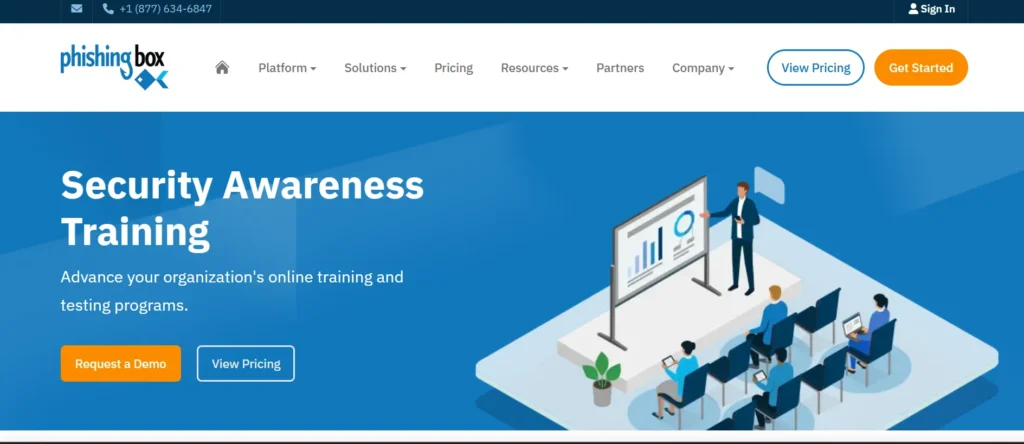
PhishingBox is a web platform that focuses on realistic and advanced phishing simulation and social engineering. The platform has a colossal, vibrant template library, which offers a range of vectors, such as email, USB baiting, and vishing. PhishingBox is very customizable and user-friendly and it does not need much technical knowledge to set up and automate workflow.
It has got a powerful Learning Management System(LMS) that has comprehensive training modules and powerful reporting capability. The main advantage of PhishingBox is that it could be adapted by the auditors and managed service providers (MSPs) to manage complex and multi-client security awareness programs with simplified and consolidated management.
Pricing:
- $1.75/ email
Key Features:
- Sophisticated Multi-Vector Simulation (Email, USB, Vishing)
- Customizable and Extensive Template Library
- Embedded LMS
- Automated Campaign Workflow
- Multi-Client Management (ideal for MSPs)
Pros:
- Highly flexible and easily automated
- Effective for running complex, diverse simulation campaigns
- Supports multiple social engineering vectors beyond email
- Strong LMS capabilities
Cons:
- Reporting features are less advanced than analytics-focused platforms
- Smaller content library compared to KnowBe4
- Less focused on behavioral analytics
8. Inspired eLearning LLC
Website: https://inspiredelearning.com/
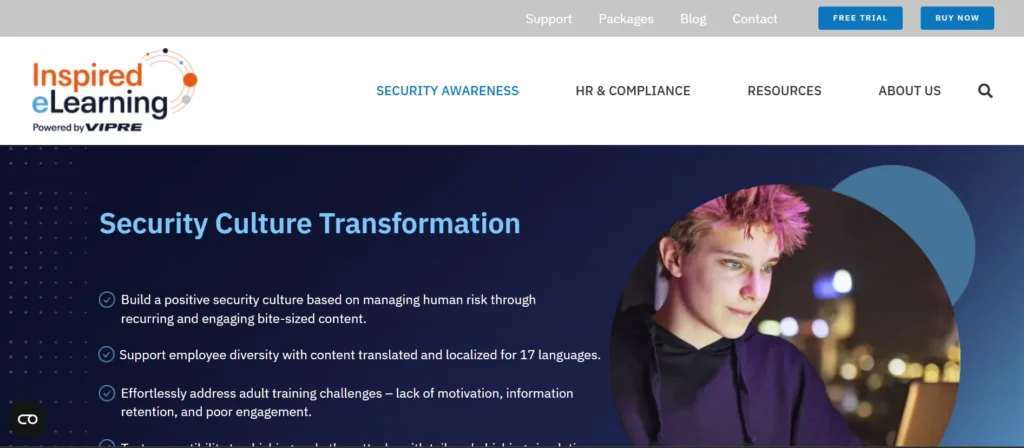
Inspired eLearning is a service provider that has a high reputation regarding its obligation to provide award-winning and high-quality and cinematic training content. The corporation is engaged in the development of attractive learning processes that emphasize retention and comprehension in its employees. Its Security First Solutions platform provides an organized, well-rounded program extending past typical compliance courses and covers the basic doctrines of data security, secure information code, and social engineering threats.
The platform emphasizes turn-key implementation, effective measurement tools to gauge the success and the return on investment (ROI) of the program; therefore, it is appropriate to those organizations that must show demonstrable changes in security posture by running education.
Pricing:
- Quote-based
Key Features:
- Film Training
- Award-Winning
- Premedicated Training Content
- Structured Curriculum (Security First Solutions)
- Automated Deployment
- PhishProof Simulation Tool
- Measurement and ROI-Analytics
Pros:
- The finest possible quality and the most engaging and entertaining content presentation
- There is a solid curriculum structure
- It can be deployed easily with turn-key
- The effectiveness of the program can be measured
Cons:
- It requires a high level of customization, which might result in higher pricing
- It is not as well integrated into real-time email security tools as Proofpoint is with its core product
9. NINJIO, LLC
Website: https://ninjio.com/
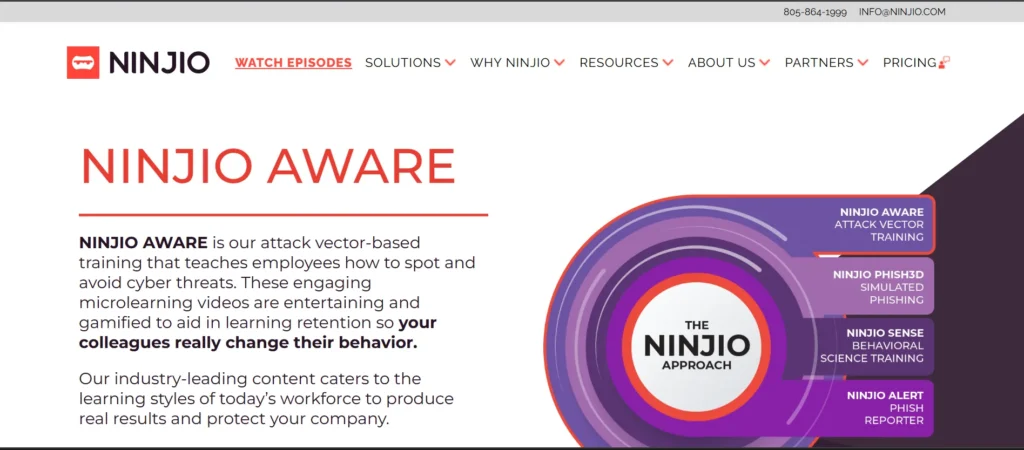
NINJIO employs a distinctive and robust strategy of utilizing monthly 3-4 minute episodes in the form of animated presentations that portray the particular and current cyber attack in the real world. The episode is a story about a recent breach, that is, an explanation of the attack entry point, human error, and the corresponding defense that is needed, and thus, the lessons are exceedingly topical and memorable.
This narrative learning is highly effective in reducing the cybersecurity risk posed by humans by tapping into human interest in the existing events. The platform created by NINJIO is oriented to lifelong learning and reduced burnout among the employees, as well as security keeps them always in mind and not overburden. The tool has quizzes and a report to gauge the understanding.
Pricing:
- Quote-based
Key Features:
- 3–4 Minute Monthly Animated Episodes (Story-Based Content)
- Extremely High Topicality Referencing Actual Breaches
- Continuous Learning System
- Quizzing and Reporting
Pros:
- Engaging storytelling that retains audience attention
- Short format reduces learner fatigue
- Content is up-to-date and relevant to real-world threats
Cons:
- Lacks long-form, comprehensive compliance modules
- Effectiveness depends on the quality and frequency of video episodes
10. SoSafe
Website: https://sosafe-awareness.com/
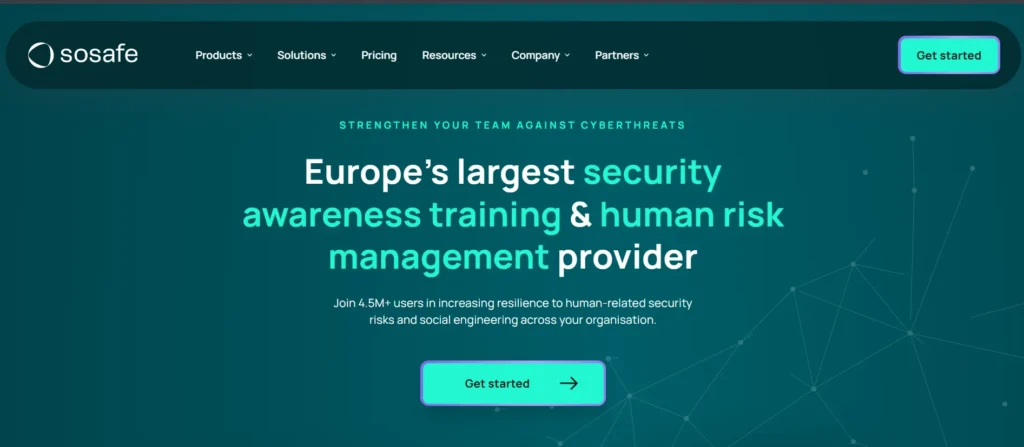
SoSafe is among the most prominent European providers of security awareness training software, placing strong emphasis on behavioral science and adaptive gamification to foster a sustainable security culture. The platform delivers hyper-personalized training based on an employee’s knowledge, role, and past simulation performance.
SoSafe applies micro-learning and interactive methods to ensure security training is relevant and continuous. Its key strength lies in its psychological approach: using positive reinforcement and role-playing to create engaging, effective security practices that reduce human risk through empathetic and contextually sensitive education.
Pricing:
- Quote-based
Key Features:
- Adaptive Training Based on Behavioral Science
- Hyper-Personalized Learning
- Game-Based Micro-Learning
- Phishing Simulator
- Multi-Language Support
Pros:
- Strong focus on psychological triggers and habit formation
- Training tailored to individual needs
- High employee engagement through gamification
- Widely adopted in European institutions
Cons:
- May not meet the deep customization needs of large North American enterprises
- Less emphasis on the traditional LMS content library
Security Awareness Training Software Comparison Table
| Software | Best For | Key Content Model | Core Analytics Metric |
| 1. KnowBe4 | Content Depth & Compliance | Largest Content Library, Kevin Mitnick Methodology | Human Risk Score (HRS) |
| 2. Proofpoint | Real-Time Threat Intelligence | Contextual Training based on Live Threats | VAP (Very Attacked People) Identification |
| 3. Cofense | Phishing Simulation Specialization | Crowd-Sourced Real-World Attack Templates | Human Susceptibility Score |
| 4. Hoxhunt | Gamified Behavioral Change | Positive Reinforcement Missions, Adaptive Micro-Learning | Reporting Rate, Time-to-Report (Dwell Time) |
| 5. Terranova Security | Multinational Compliance | Extensive Multi-Language, Policy-Centric Content | Compliance Completion, Policy Adherence |
| 6. Mimecast | Email Security Integration | Short, Humorous Animated Lessons | Risk Identification & Reporting |
| 7. PhishingBox | MSPs & Multi-Vector Simulation | Highly Customizable Templates (USB, SMS, Voice) | Simulated Failure Rate, Auto-Enrollment |
| 8. Inspired eLearning | Award-Winning Video Content | Cinematic, Structured “Security First” Curriculum | Program ROI & Measurement |
| 9. NINJIO, LLC | Current Events & Storytelling | Monthly Animated Episodes based on Real Breaches | Knowledge Retention & Low Fatigue |
| 10. SoSafe | Adaptive Psychology & Micro-Learning | Behavioral Science Nudges, Hyper-Personalization | Dwell Time, User Risk Profile |
Key Behaviors & Metrics – What Training Must Cover in 2025
Socializing the security awareness training needs to be based on modifying measurable human behaviors rather than being limited to an annual course.
1. Time-to-Report (Dwell Time): Time-to-Report:
The number of people who fail to pick up a phishing is not the most crucial parameter, but the speed with which the threat is reported by the first person. Minimizing this time (which is called Real Dwell Time) is the most important factor since it reduces the amount of time that the attacker has to move to the lateral side of the network. The training should give rise to a reflex of reporting first.
2. Learning to Art of Pretexting and Visiting:
Training should go beyond generic email Phishing, since there are more complex psychological methods of social engineering. This has pretexting (forming a convincing fake situation, e.g., Categories of these phishing attacks include but are not restricted to: I’m calling with IT to assist you with your password problem) and vishing (voice phishing), which is gaining momentum because of the artificial voice synthesis possessing AI.
3. Sufficient controls on termination:
The employees should be constantly informed about the need to use strong and unique passwords, the use of Multi-Factor Authentication (MFA) on all work accounts is needed without question and it is important that the corporate passwords are used in a safe manner. The number one attack medium is credentials.
4. Data Privacy and Handling:
The training should include the responsible handling of personally identifiable information (PII) and sensitive data that should be in line with the regulations of world standards. This consists of training on how to share files without compromising on cloud configurations, how to detect phishing by legal or other compliance reasons.
Ending Note
The best defense mechanism of countering the increasing trend of AI-powered social engineering and expensive human error is Security Awareness Training Software, the new and modern business enterprise defense mechanism. It is justifiable by the bare economic fact that the average price of a single successful data breach is several times greater than the price of comprehensive training.
The market leaders are KnowBe4, Proofpoint, and Cofense, which present powerful platforms that are aimed at tracking, testing, and changing human behavior by teaching it continuously and interactively. Through placing emphasis on platforms that have high-quality simulation engines, behavioral analytics, and contextual learning, organizations will be able to transform their employees into the last primarily responsive defensive layer of their security posture through the transformation of the weakest link.
FAQs
What Is The Human Risk Score? What Is The Measuring Method?
Human Risk Score (HRS) is the metric that is offered by platforms (such as KnowBe4 and Hoxhunt) that calculate the overall impact of human error on an organization. It is calculated by summing the information about the phishing test failure rate, the reporting rate, the training completion rate, and the time-to-report real or simulated threat. The aim is to follow the HRS trend in a downward direction.
Why Is Annual Training No Longer Effective?
The threats posed by security are becoming too fast. Annual training offers details without altering behavior in the long run or keeping an eye on the threats. Contemporary Security Awareness Training Software is founded on unremitting instruction and regular 2- or 4-quarterly micro-simulations (to accumulate and solidify the habit of see-it-report-it) so as to lower the risk.
How Is Phishing Differentiated From Spear Phishing?
Phishing is another type of bulk attack, a type of attack that targets many people (e.g., a generic email trying to impersonate PayPal). Spear Phishing is a highly specific type of attack based on the details about a particular individual, because in most cases, it uses the information gained on social media or corporate websites (e.g., an email by your CEO or a coworker in Accounting) to form a sense of trust and control of the victim.
What Is The Greatest Impediment To Effective Training Programs?
Absence of employee participation and leadership agenda. When training is regarded as a boring, compulsory affair of checking a box, employees will lose interest. Effective programs are based on engaging material (such as the animated episodes of NINJIO or the use of missions in Hoxhunt) and should involve active and visible support of the C-level executives.
What Is The Response Of Security Awareness Training Software To External Vendor/Contractor Threats?
Security Awareness Training platform enables companies to go as far as training the third-party vendors, contractors, and temporary workers. The fact that supply chain attacks are widespread means that one of the most important functions of the software is to ensure that these external parties adhere to the security awareness programs (in particular, the use of passwords and data management) as well.