

10 Best Website Vulnerability Scanners
A webpage is not a brochure in the digital economy, but at the center of transactions, communication and data of a business. Since web apps are becoming more and more complex, each time using a complex API, very large databases, and non-native microbes, more and more attackable areas increase exponentially. Even a small breach, expressed in the quantity of lost customer confidence, regulatory penalties (such as GDPR or CCPA), and time spent recuperating, is costly and therefore proactive security is a non-negotiable requirement.
Website Vulnerability Scanners are computerized, dedicated programs that use algorithms and algorithms to check and scan the website or web application to examine its security vulnerabilities, flaws, or weaknesses that can be exploited by external or internal threats. They act as a watchdog web monitor sitting on your defenses with a constant effort to find some loopholes before an unsuspecting attacker does.
The reason behind the existence of such scanners is the sheer complexity and scale of the modern threats: a single security misalignment or unpatched flaw within an out-of-date piece of equipment opens the possibility of making a catastrophic loss of data.
What is a Website Vulnerability Scanner?
A web vulnerability scanner, which is also frequently a component of a larger Dynamic Application Security Testing (DAST) offering, is an automated tool that imitates the behavior of an attacker to find weaknesses that can be exploited in a currently running web application.
How DAST Scanning Works: The Simulated Attack
It is a systematic process, and it takes place in two stages mainly:
- Crawling and Mapping (Discovery): The scanner crawls the site first, tracing links and discovering all possible input points to the site. This comprises form fields, URL parameters, cookies, HTTP headers and API endpoints. Contemporary scanners are good at scanning complex applications, such as JavaScript, AJAX, and single-page application (SPA) applications.
- Active Probing (Testing): After the input points have been mapped the scanner starts testing. It delivers a collection of purpose-built pertinent malicious inputs, called payloads, to every point. These inputs are provided to initiate known vulnerabilities (an active scan).
- Analysis and Check: The scanner compares the reaction of the application to the following payloads. A possible vulnerability can be the change of behavior, the appearance of a database error message, or the execution of a test script. More advanced DAST scanners rely on proof-based scanning (that is, performing an action that is not harmful to validate that there is an SQL injection possible) to minimise false positives.
Key Types of Vulnerabilities Targeted
- Injection Flaws (SQL Injection, AI Prompt Injection): It happens when anonymous information is treated as a command or query. The scanner inserts SQL or NoSQL malicious code to the input fields to determine whether the database will respond with a known error.
- Cross-site Scripting (XSS): Is a vulnerability that arises when rogue scripts are copied into other web pages accessed by network parties. The scanner loads a harmless script and determines whether it will run once the page has been loaded.
- Broken Access Control: Enables an attacker to circumvent authorization, and have access to privileged information (e.g. modifying an ID in a URL to access an account belonging to another user-IDOR).
- Security Misconfiguration: The errors in the configuration, which might lead to malpractices like open cloud storage buckets, default credentials, or unnecessary services being used on the server.
Why Automated Scanning is Now Essential
Web applications are now too large and complex, making it impossible to perform security review or penetration testing solely by seeking evidence of security vulnerabilities.
1. The Volume and Velocity of Threats
- Ongoing exposures: The risks to security vary due to the new code releases and new code vulnerabilities (CVEs) being found around the globe. Manual testing is single-point in time; automated DAST offers continuous security monitoring plan.
- Zero-Day Race: Hackers are always seeking zero-day vulnerabilities before the products get patented. Heuristic analysis and cloud threat intelligence technology enables automated scanners to identify suspicious behavior as it occurs, which is a vital time difference compared to reactionary patching.
2. Eliminating False Positives and Streamlining Remediation
- Scanning Proof: Proof-Based Scanning Proof-of-concept exploits Proof-based scanners such as Invicti (Netsparker) and Acunetix will automatically attempt to generate an exploit based on each vulnerability found, which is non-malicious and will see security-related tools accept it as legitimate. This can be assured to avoid developers wasting time fixing the actual bugs besides hunting the false alarms, therefore substantially improving the remediation process.
- DevSecOps Integration: Ideal scanners should be part of the development processes (CI/CD pipelines, Jira, GitHub) and generate remediation tickets to developers, including guidance on how to fix the vulnerability, as well as running retests to make sure that the vulnerability is sealed.
Also Read: Dark Web Monitoring Tools
List of Top 10 Website Vulnerability Scanners
The open source and commercial environments provide strong and specialized tools that suit various needs.
1. Invicti

- Website: https://www.invicti.com/web-vulnerability-scanner
- Focus: Dynamic Application Security Testing (DAST).
- Pricing: Quote-based (Premium enterprise).
Invicti supports large portfolios as it is scalable and Proof-Based Scanning is the best to scan it since this automatic process confirms the detected vulnerabilities. The aspect virtually removes the false positives and spares the development teams invaluable time in triage. Invicti is necessary when businesses require a high precision and deep integration into their CI/CD pipelines in order to efficiently scan complex vulnerabilities such as SQL Injection and XSS in thousands of assets.
Key Features:
- Proof-based scanner
- Robust website crawling (SPA / JavaScript support)
- Technology version tracking
- Automated WAF rule generation
- 110+ integrations (CI/CD, Jira, etc.)
Pros:
- Highest market accuracy (low false positives)
- Scanning is proof-based saving developer business time
- Scales well to thousands of assets
Cons:
- The entry-level price is quite high
- The full platform environment is very complex and may be challenging to install
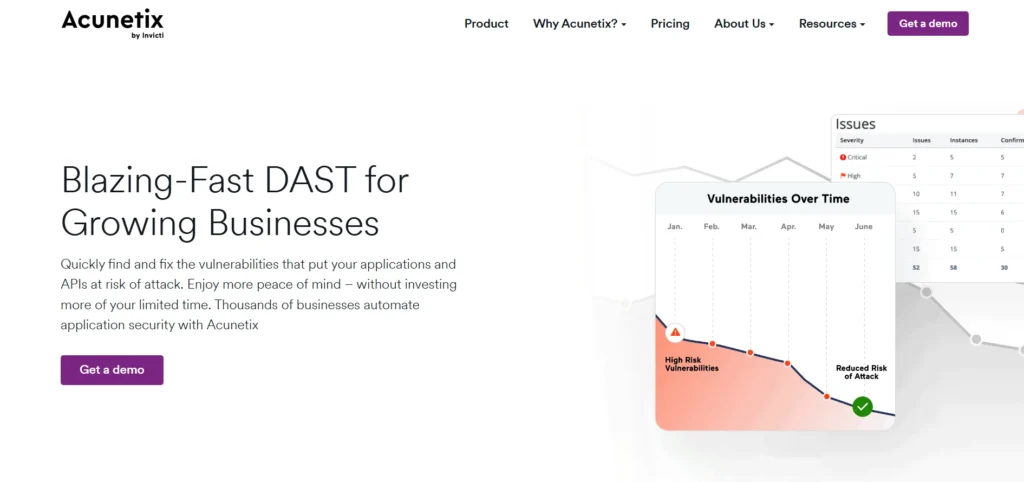
2. Acunetix
- Website: https://www.acunetix.com/vulnerability-scanner/
- Focus: Web Application New Security Scanner.
- Pricing: Asset-Based (Quote-based).
Acunetix is one of the most efficient Website Vulnerability Scanners, known for its very fast automated scanning—especially for OWASP Top 10 risks and complex vulnerabilities. It uses deep crawling technology that effectively handles single-page applications (SPAs) and JavaScript-heavy websites that older scanners often fail to detect. Its AcuSensor Technology provides IAST-like feedback, significantly improving the speed and accuracy of its reports.
Key Features:
- Deep Crawling Technology (JavaScript/PHP Spencer support Combo)
- AcuSensor Technology (IAST-like agent)
- Multi-protocol API Support (REST, SOAP, GraphQL)
- Automated Vulnerability Prioritization
Pros:
- Superior speed and accuracy
- Great skill in dealing with modern web applications and API
- Powerful remediation instructions.
Cons:
- The cost increases exponentially with the amount of applications used
- They are not simple to set up and configure
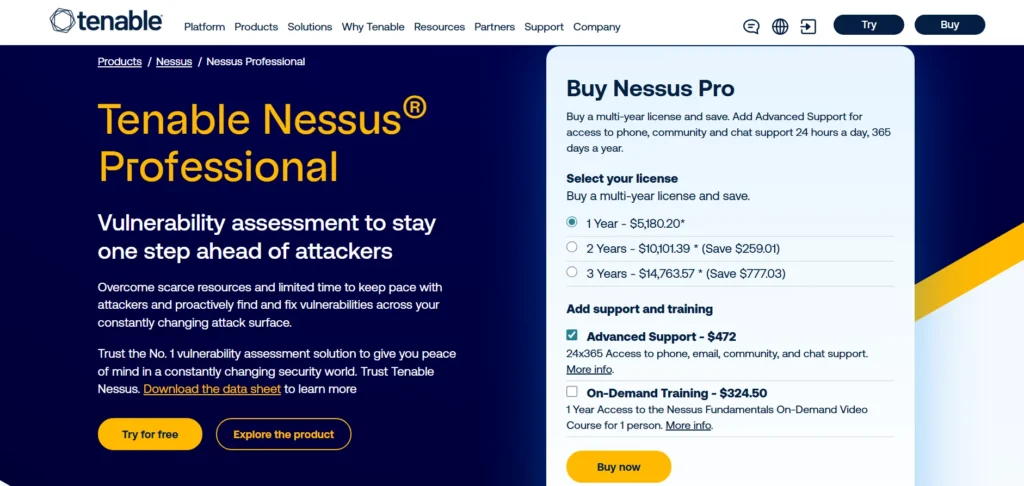
3. Tenable Nessus
- Website: https://www.tenable.com/downloads?loginAttempted=true
- Focus: Network and Host Vulnerability Assessment.
- Prices: $4,390/per year.
The Nessus system is the standard infrastructure audit system in the industry. Although it is not a pure web application scanner, its credentialed scanning and configuration inspection functionality is a fundamental finder of the weakness in the underlying web server, operating system, and open ports (that tend to support the web application). This is based on its massive and ongoing updated CVE Database (comprising more than 59,000 checks).
Key Features:
- Enormous Vulnerability Check Collection (59,000+ vulnerability scans)
- Compliance Scanning
- Certified Scanning (sweet host auditing)
- Simple, single subscription fee design
Pros:
- Industry-standard
- Trusted and solid in terms of infrastructure security
- Critical in detecting misconfigurations of web servers
- Very exhaustive reporting
Cons:
- It is not a specific web app scanner (it cannot replicate complicated XSS/SQLi attacks, which is comparable to DAST tools)
- It costs a lot as a professional license
4. Qualys Web Application Scanner (WAS)
- Website: https://docs.qualys.com/en/was/latest/scans/scans.htm
- Focus: Continuous Monitoring on the cloud.
- Pricing: Quote-based (Subscription per asset).
Qualys provides an extended cloud-based system that enables the ongoing monitoring of web applications and APIs. As one of the reliable Website Vulnerability Scanners, its benefit lies in its ability to scan external and publicly exposed applications and combine the results with wider vulnerability management and detection response (VMDR) workflows on a single platform. This holistic perspective plays a significant role in large organizations that deal with assets in cloud environments.
Key Features:
- Continuous monitoring
- API security testing
- DevSecOps integration (CI/CD), Realtime risk prioritization
- Compliance-based reporting
Pros:
- Can be integrated with the rest of the Qualys ecosystem (VMDR)
- Has good API security testing
- It can be useful when a large company needs complete and consistent cloud visibility
Cons:
- The modular per-asset pricing structure can easily become expensive
- There is a high chance of producing a false positive
Also Read: DSC Security Systems
5. Rapid7 InsightAppSec
- Website: https://www.rapid7.com/products/insightappsec/
- Focus: Vulnerability Management in Real Time.
- Pricing: Quote-based (Subscription based on applications).
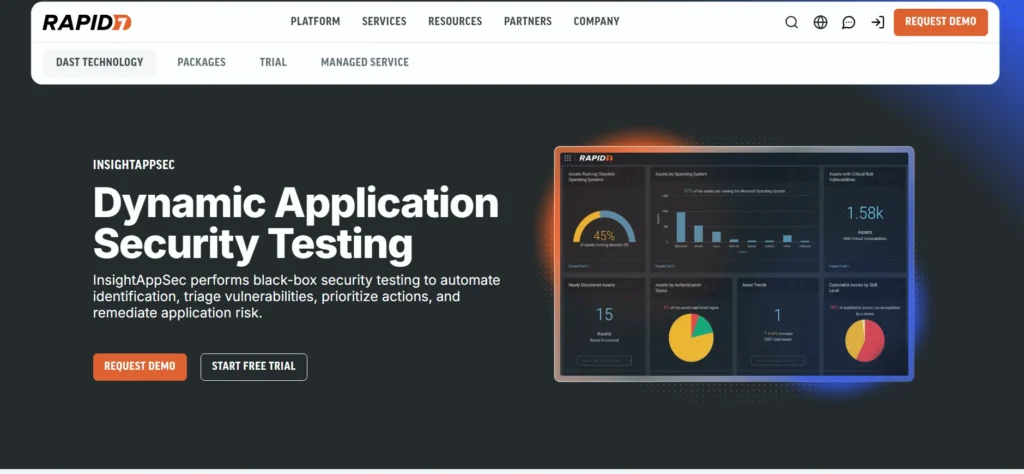
InsightAppSec applies sophisticated analytics to identify the vulnerabilities by priority, in accordance with the current risk visibility and exploitability. It fits very well within the wider security ecosystem of Rapid7 and gives great context about the relationship between an application vulnerability and network vulnerabilities and live threats. It has a deep discovery and attack of unique web technology with the aid of its Universal Translator technology.
Key Features:
- Universal Translator (discovery and attack of new unique technologies)
- Real-Time Risk prioritization
- Integration with InsightVM Unlimited concurrent scanning.
Pros:
- Good real-time risk scoring, used to rank serious problems in a team
- Integrates well with the Rapid7 security ecosystem
- It has good recommendations for developers
Cons:
- Lots of confusion and high prices in dealing with a large number of applications
- The platform necessitates constant work to ensure it runs at its full potential.
6. Burp Suite Professional
- Website: https://portswigger.net/burp/pro
- Focus: Penetration Testing and Manual/Automated DAST.
- Pricing: $475/user/year.
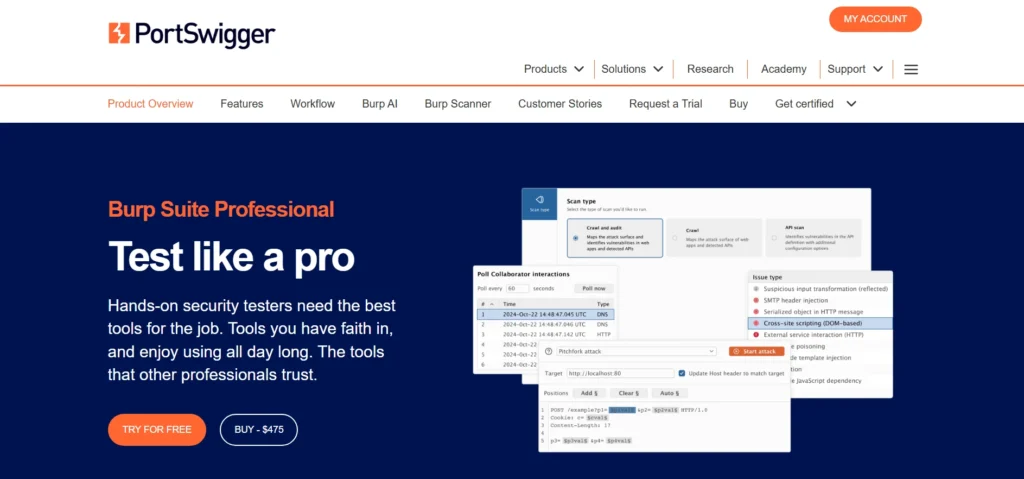
The ultimate toolkit that is used by high-end penetration testers is Burp Suite. Although it has a powerful automated scanner, which is core to it, its main advantage lies in the fact that it can be used in combination with some effective automated crawlers as well as the powerful manual tests tools (such as the Intercepting Proxy and Collaborator Client) to conduct in-depth expert-level analysis of complex application logic flaws that automated tools may overlook.
Key Features:
- Intercepting Proxy (industry standard)
- Advanced Manual Testing Toolkit
- Collaborator Client (out-of-band vulnerability detection)
- Customizable Workflows
Pros:
- Unparalleled Versatility in manual testing and logical component testing
- The Professional Edition is low costs (best value is where individual testers are concerned)
- Excellent automated scanner provided
Cons:
- The automating capabilities of scans are not quite as scalable as Invicti or Acunetix; it needs a lot of expertise to be fully used.
7. Open Vulnerability Assessment System (OpenVAS)
- Website: https://www.openvas.org/
- Focus: Open-source Network and Web Scanning.
- Pricing: Free (Open Source Community Edition).
OpenVAS offers a professional-grade and fully featured solution that includes an extensive and regularly updated community feed of vulnerability tests, making it one of the most reliable Website Vulnerability Scanners for organizations on a budget. It scans the underlying infrastructure and network devices and is based on the original Nessus codebase. Nonetheless, it demands strong technical skills (especially Linux knowledge) to be optimally configured and maintained.
Key Features:
- Standard, periodically updated community feed
- Unauthenticated and Authenticated test Fixed tested
- Powerful internal programming language
- Custom test writing.
Pros:
- The software is absolutely free and open
- Can be used by an enterprise on a low budget
- Has a well-developed community and is actively developed
Cons:
- The installation and the maintenance require considerable technical skills (Linux knowledge)
- Reporting and compliance capabilities are not as polished as its commercial competitors
8. OWASP ZAP (Zed Attack Proxy)
- Website: https://www.zaproxy.org/
- Focus: Mobile-DAST.Open-source Code Development.
- Pricing: Free (Open Source).
ZAP is an open-source, free, and very user-friendly tool that targets specifically developers and security-new testers. It is also very useful in identifying weaknesses during the early stages of the development lifecycle (“Shift Left” security), provides automated scanning in addition to a powerful collection of manual tools through a user-friendly interface. It is suitable to add to CI/CD pipelines because of its API Automation capabilities.
Key Features:
- Active and passive scanning
- API automation (through API calls)
- AJAX spidering (complex JavaScript is also supported)
- Fuzzer tool
- Built-in learning environment
Pros:
- Developer and security beginner (this is why it is called Shift Left)
- Extensible and very customizable, with an active community
Cons:
- This is very laborious to do in complex authenticated scans on the high level
- It has to be automated, which needs some knowledge of scripting
Also Read: VPN For Windows
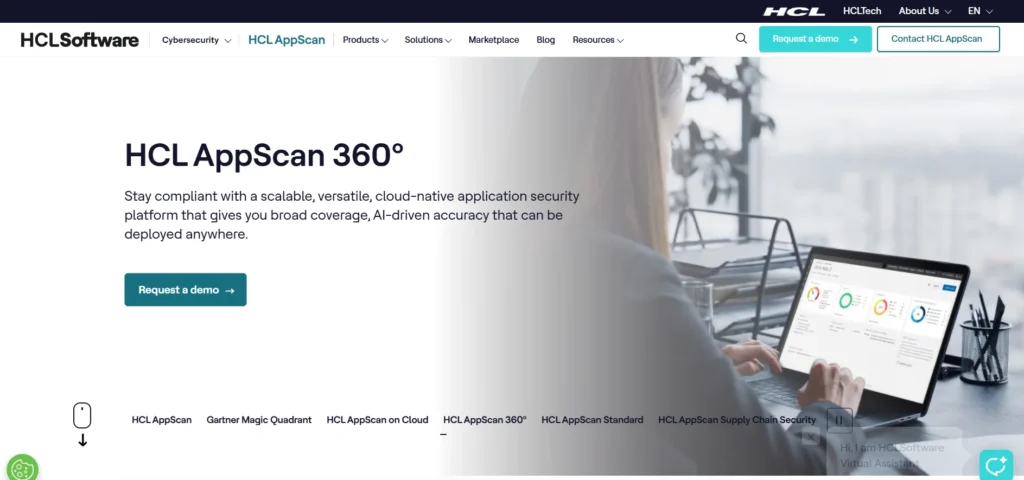
9. HCL AppScan
- Website: https://www.hcltechsw.com/appscan
- Focus: Enterprise application security (SAST/DAST/IAST).
- Pricing: Quote-based (High-tier enterprise).
AppScan is an enterprise-level platform, widely recognized among top Website Vulnerability Scanners for its ability to integrate Static Analysis (SAST) and Dynamic Analysis (DAST). It analyzes both running code and source code to identify vulnerabilities in a more comprehensive and detailed manner throughout the Software Development Lifecycle (SDLC). Its cost is relatively high because it also offers extensive compliance and reporting features.
Key Features:
- Hybrid Analysis potency (Integrates Static and Dynamic scanning)
- Fully developed Compliance Reporting
- Automatic Vulnerability Identification
- Widely ranged API Security testing
Pros:
- Good combined SAST/DAST analysis have better coverage
- Good history performance in the application security market
- Wholesome in terms of compliance requirements.
Cons:
- The barrier of entry and implementation cost is steep in the full suite
- Not transparent in pricing (mostly quote-based)
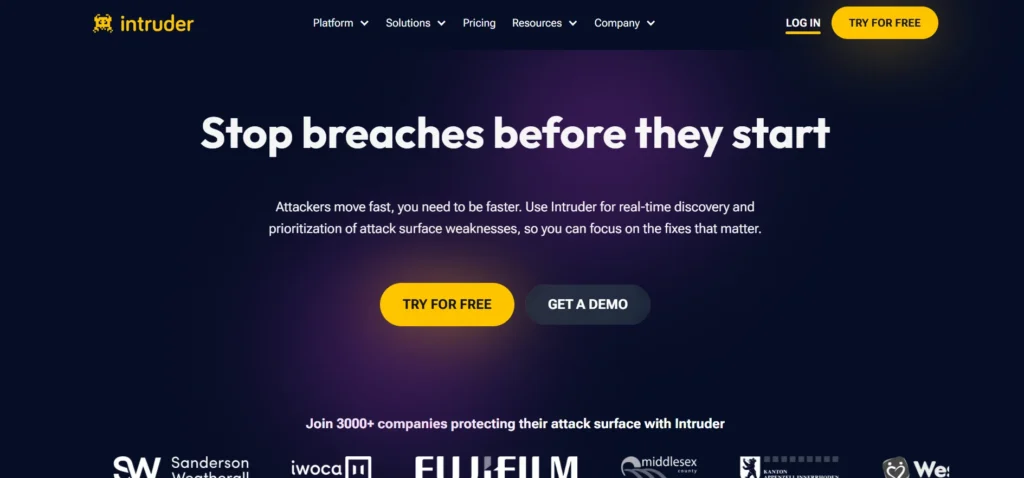
10. Intruder
- Website: https://www.intruder.io/
- Focus: Web-based Continuous monitoring and User-friendliness.
- Pricing: $149/month.
Intruder is a cloud-based scanner that has given great attention to continuous monitoring and ease to the SMBs. It actively investigates the public attack surface of an organization, consisting of cloud, web applications, and provides automated scans and detailed and user-friendly reports on possible threats. The fact that it is simple and oriented toward finding Emerging Threats as quickly as possible makes it incredibly important to small security teams.
Key Features:
- Nonstop proactive monitoring
- Emerging threat scans
- Cloud Security Posture Management (CSPM)
- Simple and user-friendly interface
Pros:
- Good to keep an uninterrupted eye on any external attack surface
- Extremely simple to install and operate
- Active scans against potential systems breaking down
Cons:
- There is less historical information in the reports than with competitors
- There is a lower level of configuration amongst power users
Website Vulnerability Scanner Comparison Table (2025)
| Tool Name | Core Focus (DAST) | Model (Commercial / Open Source) | Key Verification Feature | Cost (Approximate Entry) | Best For |
| 1. Invicti | Web Application (DAST) | Commercial | Proof-Based Scanning (Zero False Positives) | Quote-based (High) | Enterprises Seeking High Accuracy |
| 2. Acunetix | Web Application (DAST) | Commercial | Deep Scanning of Complex JS/SPAs | Quote-based (Medium/High) | Web Dev Teams & Advanced Crawling |
| 3. Tenable Nessus | Network/Host/Server | Commercial | Extensive CVE Database (59,000+ checks) | ~$4,390/year | Auditing Underlying Infrastructure |
| 4. Qualys WAS | Web Application (Cloud) | Commercial | Continuous Monitoring & Cloud Integration | Quote-based | Large Enterprises (Holistic VMDR) |
| 5. Rapid7 InsightAppSec | Web Application (DAST) | Commercial | Real-Time Risk Prioritization | Quote-based | Organizations with Large App Portfolios |
| 6. Burp Suite Pro | Web/API Testing | Commercial/Manual | Intercepting Proxy & Manual Tools | ~$449/user/year | Professional Penetration Testers |
| 7. OpenVAS | Network/Server | Open Source | Regularly Updated Community Feed | Free | Budget-Conscious Infrastructure Scanning |
| 8. OWASP ZAP | Web Application (DAST) | Open Source | Developer-Friendly Interface / Automation | Free | Developers & Security Beginners |
| 9. HCL AppScan | Application (SAST/DAST) | Commercial | Hybrid Static/Dynamic Analysis | Quote-based (High) | Enterprises Requiring SDLC Integration |
| 10. Intruder | External Attack Surface | Commercial (SaaS) | Continuous Proactive Monitoring | ~$100/month | SMBs Seeking Simple, Continuous Cloud Scans |
Conclusion: The Continuous Necessity of Digital Defense
A website is the best resource of contemporary business and the most significant single exposure to cyberspace. Considering the complexity that comes with modern-day web applications—built with many libraries of code, complex APIs, and dynamic content—security can no longer be a periodic task. This is why using reliable Website Vulnerability Scanners has become a constant requirement to identify risks early and safeguard your digital presence.
Today, the market has the strength of specialized tools that help to address this challenge. To organizations that have their critical aspects based on optimal efficiency and developer time savings, DAST channels such as Invicti and Acunetix offer the finest with automated and proof-based scanning, which excludes false positives. In cases where a wide infrastructure compliance is the priority, Tenable Nessus is the ultimate tool to be used to scan the underlying host and server setup. In the meantime, OWASP ZAP provides a free entry of developers who adhere to the ethos of shifting left and discovering vulnerabilities at the earliest stages.
Finally, to only use manual penetration tests would be acknowledging that it would be susceptible to certain moments. Use of a well-developed, automated DAST scanner, which is clearly incorporated into the lifecycle, constantly ensures that the digital guardian of a business is on the alert, ready to be used against it by an ill-intentioned hacker, and it forms the basis of its business.
FAQs
1. What is the Underlying Distinction between SAST and DAST?
Before an application starts, the source code is scanned by SAST (Static Application Security Testing) to reveal vulnerabilities in the code written. DAST (Dynamic Application Security Testing) attempts to scan the executing application externally, representing the perspective of a hacker (black-box testing) to identify weaknesses in the application execution, configuration and interfaces. Most vulnerability scanners carry out DAST.
2. Why is Proof-Based Scanning Important to Enterprise Tools?
Invicti (which uses proof-based scanning) automatically knows that a given vulnerability is a real vulnerability and is exploitable rather than a false positive. This aspect saves development teams a lot of time and resources that would be used to track non-existent defects.
3. Would a Vulnerability Scanner be able to substitute a Manual Penetration Test?
No. Vulnerability scanners are great at large scale (SQLi, XSS) due to their possession of known vulnerabilities. Nonetheless, manual penetration tests have to be done to identify complicated business logic bugs, chaining bugs, and distinct vulnerabilities that need human judgment and knowledge. Scanners do the very simple one and the intricate hitches are left to human testers.
4. What is the OWASP Top 10, and Why are Scanners Interested in it?
Open Web Application Security Project (OWASP) has put together a list of the top 10 security risks to web applications (the OWASP Top 10). The reason behind the attention of scanners to these threats is that they are the most prevalent and harmful attack vectors (Injection, Broken Access Control, Security Misconfiguration).
5. Why do Older Scanners have Difficulty with scanning single-page Applications (SPAs)?
The scanners which were in use before were configured to work with traditional, static web pages. React or Angular-based SPAs have been developed with the use of complex JavaScript to bring content onto the page once it has loaded. The elderly scanners cannot usually implement this JavaScript and therefore do not complete the map of the application; and are also marked as missing any vulnerabilities.